For teams researching new building permit regulations, the first question is whether a change applies to the project now or only after its effective date and transition rules take effect. A proposed amendment, an adopted change, and a requirement currently in force can call for different decisions about plans, permit documents, and review.
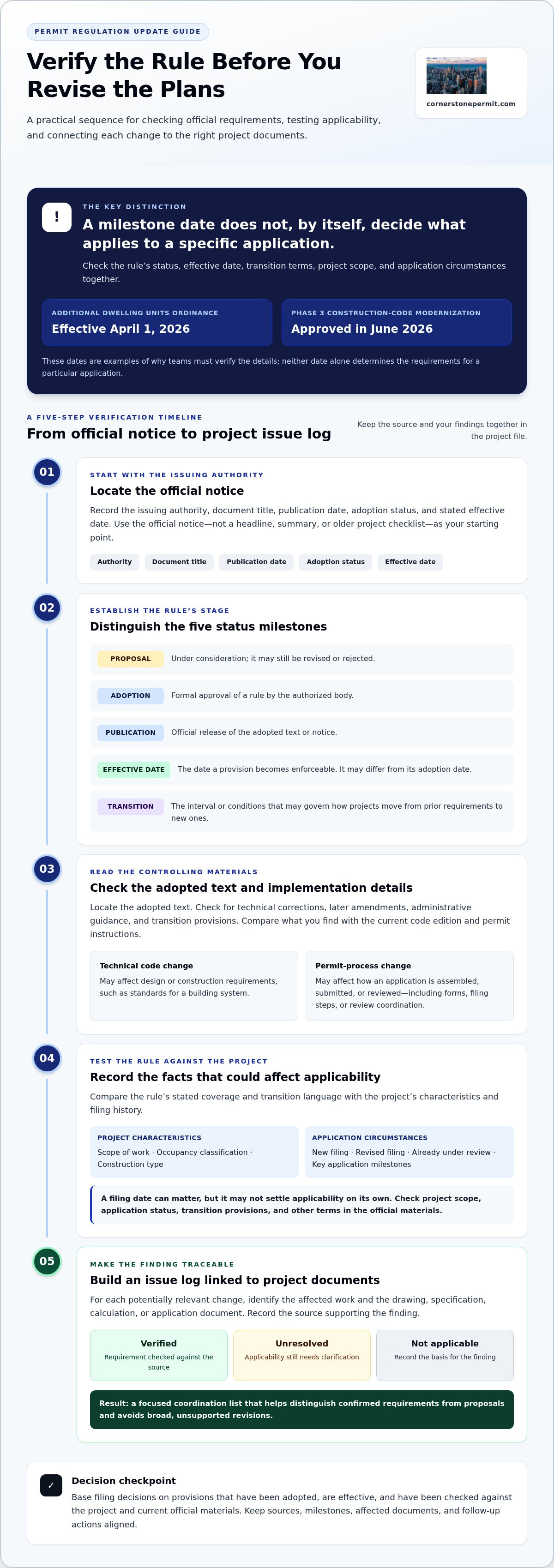
Recent updates illustrate why project teams need to verify the details. An Additional Dwelling Units ordinance took effect April 1, 2026, and Phase 3 of construction-code modernization was approved in June 2026. Neither date alone determines what applies to a specific application. Scope, permit pathway, and transition rules all matter.
Cornerstone Permit Company provides this guide to explain how to check current requirements against official records, assess their potential effect on project scope and submitted documents, and organize a complete permit application. It also covers tracking review comments and follow-up requirements, so you can distinguish a general regulatory update from the provisions that may affect your project.
Key Takeaways
- Verify each permit requirement’s official source, status, effective date, and transition terms before applying it to a project.
- Use a change-impact table to connect applicable provisions to affected work, documents, responsible roles, and verification status.
- Record project characteristics and application milestones to assess which requirements may apply.
- Coordinate plans, specifications, calculations, and application narratives, then track review comments and follow-up actions.
- Permit-management support can organize application materials, review milestones, and administrative responses while keeping compliance coordination distinct from design and legal responsibilities.
What a new building-permit regulation can change for a project
A permit regulation update may change the code, application procedure, required documentation, or review process for a construction project. Its practical effect depends on what the update covers and whether it applies to the project’s scope, occupancy, construction type, and application circumstances. A general announcement alone does not establish that a project must be redesigned or resubmitted.
To determine which requirements govern a project, identify the controlling text and its status. A published proposal, an adopted rule, and an effective requirement are distinct stages, each with different implications for planning and permit documents.
How code changes differ from permit-process changes
A code change affects technical requirements for design or construction, such as standards that apply to a building system. A process change affects how an application is assembled, submitted, or reviewed, including forms, filing steps, or review coordination. Either type may require action, but the affected documents and workflow can differ.
Hypothetical example: A technical amendment could prompt a team to reassess a detail in its drawings, while a revised submission procedure could require the team to reorganize application materials. This example is illustrative, not a description of a specific 2026 rule.
Why adoption and effective dates matter
These stages have distinct meanings:
- Proposal: A change under consideration that may still be revised or rejected.
- Adoption: Formal approval of a rule by the authorized body.
- Publication: Official release of the adopted text or notice.
- Effective date: The date a provision becomes enforceable.
- Transition period: A defined interval or set of conditions that may govern how projects move from prior requirements to new ones.
Code adoption is formal approval of a code or amendment. The effective date is when the adopted provision becomes enforceable. Those dates may differ. A project’s filing date can matter, but it may not settle applicability on its own. Transition provisions, application status, project scope, or other terms may also be relevant.
Before changing plans or preparing a submission, review the official notice, adopted text, current code edition, implementation guidance, and permit instructions. Record the provision’s status, effective date, and transition language, then compare them with the project’s characteristics and filing milestones. This helps separate confirmed requirements from proposals and focus any plan or application review on the relevant issues.
How to verify which 2026 building requirements are actually in force
A reliable compliance decision starts with the rule itself, not a summary, headline, or older project checklist. Check each potentially relevant update against current official records, then connect its status and effective date to the project’s scope and application history. This helps distinguish an enforceable requirement from a proposal or past milestone.
A practical source-checking sequence for code updates
Start with the issuing authority’s official notice. Record the document title, publication date, adoption status, and stated effective date. Then locate the adopted text and check for technical corrections, later amendments, administrative guidance, and transition provisions. Before revising plans or application materials, compare those records with the current code edition and permit instructions.
Keep the source and findings together in the project file. If a notice points to a separate implementation document, review it too, since procedural directions may clarify how an adopted requirement is administered. A modernization timeline can explain the history of code updates, but an earlier adoption or mandatory date does not prove that a particular 2026 provision applies to a current filing.
How to assess applicability to a specific application
Record project facts that could affect applicability, including scope of work, occupancy classification, construction type, and key application milestones. Note whether the filing is new, revised, or already under review. These details provide a basis for comparing the project with the rule’s stated coverage and transition language.
Build an issue log that links each potentially relevant change to the affected drawing, specification, calculation, or application document. Mark each item as verified, unresolved, or not applicable, and record the source supporting that status. This makes the reasoning traceable and gives the team a focused coordination list instead of prompting broad, unsupported revisions.
- Source: Issuing authority and official document title
- Status: Proposal, adopted text, or effective requirement
- Timing: Publication, effective date, and applicable transition terms
- Project link: Affected scope, document, and application milestone
Base filing decisions on provisions that have been adopted, are effective, and have been checked against the project and current official materials. When the applicability review creates document or coordination tasks, organized permit application management can help keep sources, milestones, and follow-up actions aligned.
How regulatory changes affect plans, review, and project coordination
A verified regulatory change may affect one document, several coordinated deliverables, or only the application workflow. Its impact depends on the provision and project conditions. It does not automatically require revisions to every plan. Map possible effects before assigning updates to distinguish required changes from precautionary edits.
Translate a code update into document-review tasks
Compare the verified requirement with relevant plans, specifications, supporting calculations, and the application narrative. Assign each necessary action to the responsible project-team member, track completion, and keep a dated record of the source and rationale. A document-impact table makes the review traceable:
| Provision | Affected scope | Document | Responsible party | Verification status |
|---|---|---|---|---|
| Verified provision under review | Project element covered by the text | Relevant drawing or specification | Assigned discipline lead | Open, verified, or not applicable |
| Related documentation requirement | Application materials in scope | Calculation or narrative | Application coordinator | Source and applicability recorded |
Use the table to identify dependencies as well as individual edits. A drawing revision may require a matching specification update or a change to an application narrative. Confirm consistency before consolidating the submission.
Coordinate plan review comments and revisions
Keep regulatory changes separate from reviewer comments and unresolved design questions. Each has a different source and resolution path. Log the issue, affected document, assigned responder, and status. Then consolidate responses so revisions across disciplines remain aligned.
A late discovery may lead to clarification requests, plan revisions, or resubmission, depending on the requirement and review status. Record why each change is being made and identify the related review comment or verified provision. For broader review coordination, consult Commercial Building Permit Expediting: Complete Guide to Plan Review and Approvals. If an application is rejected or requires correction, the Permit Rejected? Contractor’s 2026 Action Checklist offers a related action framework.
This document-level workflow turns verified requirements into specific, assigned tasks rather than broad assumptions. Permit management and plan-review coordination can help maintain the issue log, organize application materials, and track administrative follow-up while the responsible project professionals address technical revisions.
A project-team checklist for managing a building-permit rule change
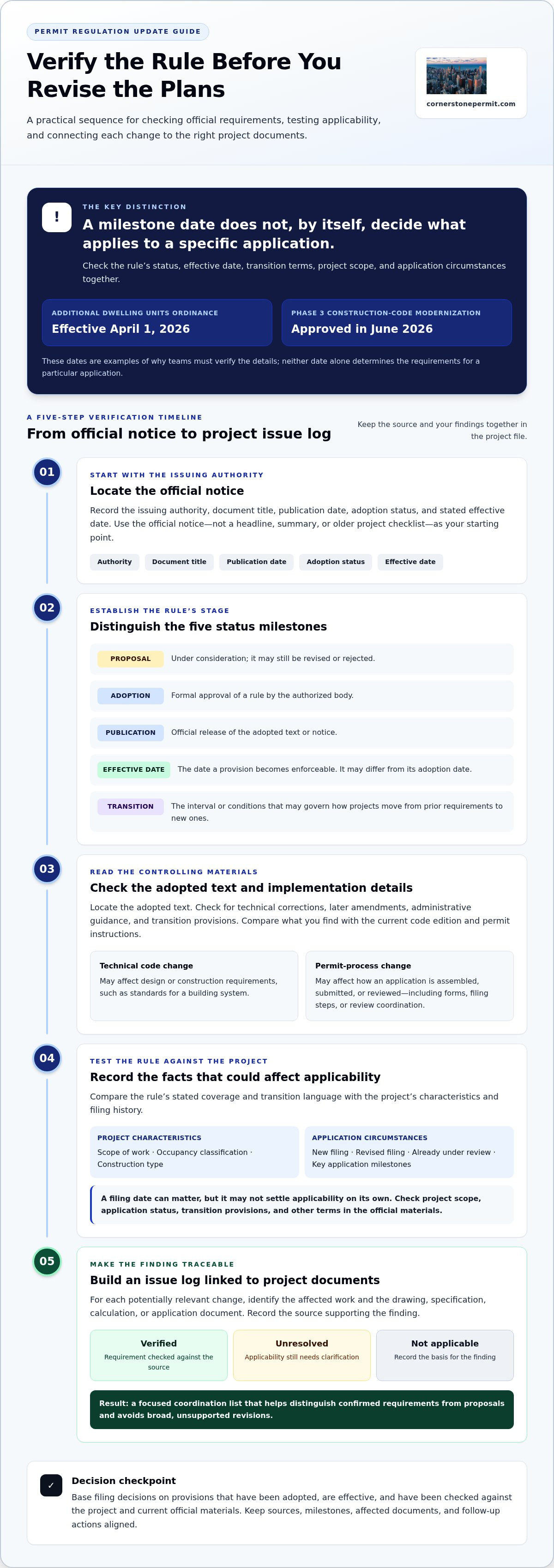
A documented change-control process helps prevent regulatory updates from becoming untracked plan edits or missed review tasks. Assign an owner to verify the rule, document its applicability, and coordinate any resulting revisions. Adapt this checklist to the project’s scope and application status.
Before filing or revising an application
Confirm the current code edition and permit instructions against authoritative materials, then record the source and result of the applicability review. Compare the project’s scope and filing status with any transition provisions before deciding whether submitted documents need to change.
- Verify the rule: Record the issuing authority, document title, adoption status, effective date, and relevant transition provisions.
- Capture project facts: Note scope, occupancy classification, construction type, and key application milestones.
- Review the package: Compare potentially affected plans, specifications, calculations, and application narratives with the verified requirement.
- Assign ownership: Identify the person responsible for each document revision, technical review, application coordination, and final submission.
Keep a change log with the source reference, applicability decision, revision rationale, responsible role, review status, and approval record. If a requirement does not apply, record the basis for that decision as well. A clear record lets the team revisit its reasoning if the project scope or filing status changes.
While an application is under review
Monitor the official application status and preserve review communications with the project record. Route each comment to the appropriate project professional, assign an owner to coordinate the response, and track it through submission and follow-up. Keep regulatory changes distinct from review comments so the team can see why each document was revised.
- Log the date and source of each official communication.
- Connect every comment to the affected drawing or application document.
- Coordinate related revisions across disciplines before submitting a response.
- Update the change log with the response, submission milestone, and resulting review status.
Use How to Expedite a Building Permit: A Practical Guide for 2026 for related process guidance, while following current official instructions for the specific application. A consistent record of sources, assignments, and review actions helps teams manage new building permit regulations in the city of Chicago without relying on assumptions or disconnected email threads.
Structured permit application management and review coordination can keep documents, responsibilities, and follow-up aligned. Learn about organizing your permit application process.
How permit-management support helps keep compliance work organized
Once a project team understands which requirements apply, the next task is maintaining a clear application workflow. Permit-management support organizes materials, tracks review milestones, and coordinates administrative follow-up, keeping regulatory requirements connected to project documents and schedule.
What permit application management can cover
Application management can support the process from preparation and submission through plan review and follow-up. A centralized document and comment log helps the team track what was submitted, what reviewers requested, who is responsible for each response, and whether revised documents have been coordinated across disciplines.
For example, if a review comment requires clarification in an application document and a related drawing, the log can connect both items to the comment, identify the responsible project professionals, and record the status of each response. This creates a consistent reference for project communications without promising a particular approval decision or processing speed.
When to bring in regulatory process support
Additional coordination can be useful when a project has a complex scope, multiple review comments, or uncertainty about filing requirements. Starting document review early can surface missing information and coordination gaps before submission, giving the project team time to address them in an orderly way.
Cornerstone Permit Company provides building-permit management, plan-review coordination, and building-code consulting to help project teams organize compliance work and application workflows. This support focuses on regulatory and administrative coordination. It does not replace the work of design professionals responsible for technical plans or legal counsel responsible for legal advice.
For project teams evaluating new building permit regulations in the city of Chicago, the same disciplined process applies: connect verified requirements to project documents, assign follow-up, and maintain a clear record of review activity. Discuss your project scope, documentation, and permit-review coordination with Cornerstone Permit Company.
Turn verified requirements into a coordinated permit application
Regulatory updates should guide project decisions only after their status, effective date, and applicability have been verified. Connect each relevant requirement to affected plans or application documents, assign responsibility for revisions, and keep review comments and follow-up actions in a clear project record. This process helps teams respond to new building permit regulations in the city of Chicago with facts rather than assumptions.
Cornerstone Permit Company has supported permit processes since 2014 and is a Certified Minority Business Enterprise. Its building-permit management, plan-review coordination, and building-code consulting help organize application materials and administrative follow-up. This support coordinates compliance work; it does not replace design professionals or legal counsel.
Discuss permit management for your project to align project scope, documentation, and review coordination. With verified requirements and an organized workflow, your team can move forward with greater clarity and control.
Frequently Asked Questions
What building-permit regulations changed in 2026?
Several 2026 updates addressed accessory dwelling units, construction-code provisions, and permit procedures. An accessory dwelling unit ordinance took effect April 1, 2026, and Phase 3 of code modernization was approved in June. New demolition applications moved to an online portal on August 10, 2026; applications started before August 6 may use the prior process until December 30, 2026. Approval of a code phase alone does not establish when each provision becomes enforceable, so verify its effective date and applicability before relying on it.
How can I tell whether a building-code update is in effect?
Check the official notice and adopted text, then confirm the provision’s status, effective date, and any transition terms. Cross-check those details against the current code edition, implementation guidance, and permit instructions. A proposal or adoption announcement is not enough to establish that a requirement is enforceable for your filing. Record the sources and compare the rule with the project’s scope, occupancy, construction type, and application milestones before changing documents.
Do new building-permit rules apply to an application already under review?
They may, but an application’s review status or filing date alone may not decide the issue. The adopted text and transition provisions may define which applications are governed by a change, including whether a revised submission is treated differently from an application already in review. Compare the project’s filing and revision milestones with current official guidance. If applicability remains unclear, document the question and seek clarification through the appropriate official review channel before altering the submission.
What project documents might need revision after a code change?
Depending on the verified provision and project scope, affected materials could include drawings, specifications, supporting calculations, and application narratives. A change affecting one building system, for example, may require a corresponding plan detail and specification review, while an administrative update may affect submission materials rather than technical plans. Log each relevant provision against the document it may affect, assign an owner, and coordinate related revisions so the submitted package remains consistent.
Can a code change delay a building-permit application?
It can contribute to additional review work if a newly applicable requirement prompts clarification, document revisions, or resubmission. That outcome is not automatic. It depends on the rule, its applicability, the application’s status, and the documents already submitted. Verifying requirements before filing, maintaining a clear change log, and coordinating responses across project disciplines can help the team address potential issues systematically. Do not assume an update causes a delay without confirming its effect on the specific application.
Who can help manage building-permit requirements and review comments?
Cornerstone Permit Company supports permit application management, plan-review coordination, and building-code consulting. The team can help organize application materials, track review milestones, and coordinate administrative follow-up, while design professionals remain responsible for technical design decisions and legal questions remain with legal counsel. Founded in 2014, Cornerstone is a Certified Minority Business Enterprise. This project-management support helps keep requirements, document tasks, and review communications organized throughout the application process.