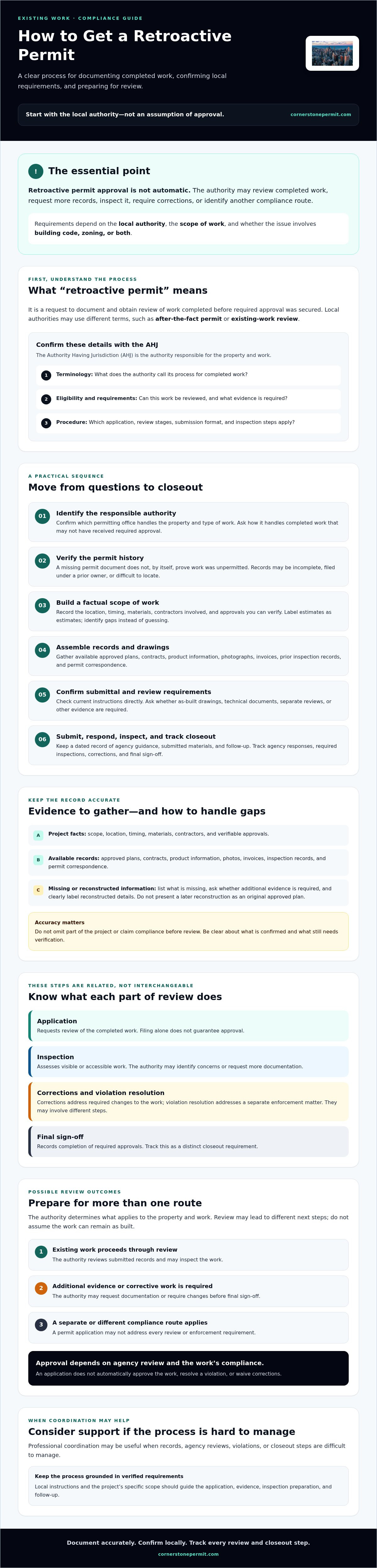
What if work you’ve already completed can’t be approved as it stands? If you’re researching how to get a retroactive permit, treat the matter as a compliance review, not an automatic path to approval. Requirements depend on the local authority, the work involved, and whether the issue concerns building code, zoning, or both.
It’s reasonable to be concerned about inspections, corrective work, added fees, and delays, especially when plans or records are incomplete. Start by confirming which authority handles the property and asking what it requires for completed work. Depending on the jurisdiction and project, you may need to document existing conditions, prepare as-built plans, submit an application, and complete required corrections before final sign-off. This guide explains how to identify the applicable process, assemble an accurate record, and prepare for review and inspection. It also covers how to compare possible compliance paths and track closeout requirements, while keeping in mind that approval depends on agency review and the work’s compliance.
Key Takeaways
- To understand how to get a retroactive permit, confirm the authority’s terminology, review process, and requirements for existing work.
- Build a factual record of the work, including its scope, location, timing, materials, and any approvals you can verify.
- Compare compliance paths before filing. Permit review, required corrections, and violation resolution may involve different steps.
- Track the process from confirming submittal requirements through agency responses, inspections, and closeout.
- Consider professional coordination if records, reviews, violations, or closeout steps are difficult to manage.
How to Get a Retroactive Permit: What It Means and When It May Apply
A retroactive permit is a request to document and obtain review of work completed before required approval was secured. The term isn’t used consistently. An authority may call the process an after-the-fact permit, an existing-work review, or something else. Before deciding how to get a retroactive permit, contact the Authority Having Jurisdiction (AHJ) for the property and confirm its terminology, eligibility criteria, and application steps.
A permit application is only one part of compliance. The authority may also require an inspection, supporting documents, corrections, resolution of a separate violation, and final sign-off. These steps serve different purposes: filing requests review, an inspection assesses visible or accessible work, violation resolution addresses an enforcement matter, and final sign-off records completion of required approvals. The Building code provides context for why construction is regulated, including the protection of public health and safety. The requirements that apply to a specific project depend on the jurisdiction and scope of work.
What counts as work completed without a permit?
Work may include an alteration, installation, or addition, but only if local rules required a permit for that specific scope. A missing permit document doesn’t, by itself, prove the work was unpermitted. Records may be incomplete, filed under a prior owner, or difficult to locate. Check the property’s permit history and available project records before drawing conclusions. In your notes, separate confirmed details from information that still needs verification.
Can completed work still be reviewed?
An AHJ may have a process for reviewing completed work, but availability, required evidence, and outcomes vary. The review may involve submitted records and an inspection. Neither guarantees approval without further action. The authority may identify safety or code concerns, request more documentation, or require corrective work. Requirements specific to the property and scope still apply even though construction is complete.
This distinction matters when planning next steps. An application doesn’t guarantee approval, resolve an enforcement issue, or automatically waive corrections. The authority may allow the existing work to proceed through review, require changes, or identify a different compliance route. Confirm the process before committing to a schedule or assuming the work can remain as built.
Assess the Existing Work Before You Apply for a Retroactive Permit
A reliable application starts with a clear account of what was done and which agency has authority over it. Confirm the responsible permitting office for the property and type of work. Ask how it handles completed work that may not have received required approval. This check can help you identify the right procedure before assembling documents or making assumptions about eligibility.
Prepare a factual scope of work. Note where the work is within the property, when it was completed, what materials were used, which contractors were involved, and what approvals you can verify. If dates or details are estimates, label them as such. Identify gaps rather than filling them with guesses. Be accurate about the work’s condition. Omitting part of the project or claiming compliance before review can complicate the record and agency response.
Which records and drawings should you gather?
Collect available approved plans, contracts, product information, photographs, invoices, prior inspection records, and permit correspondence. These materials can help show what was planned, installed, or previously reviewed. If records are incomplete, list what is missing and ask the authority whether it requires as-built drawings, technical documents, or other evidence. Label reconstructed information clearly, preserve original documents, and don’t present a later reconstruction as an original approved plan.
How should you identify the authority’s requirements?
Check the permitting office’s current instructions directly. Confirm the application form, submission method and format, review stages, and inspection procedure for the specific work. Ask whether separate reviews or approvals may apply, since a single permit may not address every requirement. The Redfin overview of unpermitted additions also illustrates why property records and permit history matter when evaluating completed work.
Keep a dated record of agency guidance, submitted materials, and follow-up. Requirements depend on the property and scope, so a general checklist shouldn’t replace confirmation with the authority responsible for your application. If organizing records or coordinating permit and compliance steps is proving difficult, permit application coordination may help keep the process organized, without implying that approval is assured.
Retroactive Permit Approval Is Not Automatic: Compare the Available Compliance Paths
Submitting an application starts a review; it doesn’t promise approval or prevent enforcement. The authority determines what documentation, inspections, corrections, and closeout steps apply. Depending on its findings, the next step may be continued review, corrective work, a separate response to a violation, or a combination of these paths.
Use this comparison to frame questions for the permitting office, not to predict its decision. The appropriate route depends on the work, local procedures, and any existing enforcement record.
| Compliance path | When it may apply | Who determines it | What remains uncertain |
|---|---|---|---|
| Seek review of completed work | The authority accepts an application or process for evaluating existing work. | The responsible permitting authority sets the process and reviews the submission. | Whether the application is accepted, what further evidence is needed, and whether the work can be approved as documented. |
| Complete required corrections | Plan review or inspection identifies information gaps or conditions that need to be addressed. | The authority identifies required corrections; qualified professionals may be needed to assess or perform work. | The scope of corrections, access needed to assess concealed conditions, and whether further review will follow. |
| Resolve a related violation | A citation, order, or other enforcement matter is open in addition to the permit issue. | The agency responsible for the enforcement matter determines its response and closeout requirements. | Whether separate submissions, inspections, deadlines, or final approvals apply. |
When might an application require corrections or further review?
A plan review may request clearer records or additional technical information. An inspection may identify conditions that need further assessment. If relevant work is concealed, the authority may require access or other evidence, depending on its procedures and the project. Don’t assume what must be opened, tested, or changed. Ask the reviewer to clarify the required next step before arranging work.
How is a permit application different from violation resolution?
A permit addresses authorization and review of the work. A violation concerns an enforcement matter and may require a separate response. Obtaining a permit alone may not close a citation, order, or inspection issue. Confirm with each responsible agency whether violation closeout, a final inspection, or a certificate-of-occupancy step also applies.
To assess how to get a retroactive permit for a specific property, establish which paths the authority requires and whether they must proceed together. Track application review and enforcement closeout separately until the agency confirms the status of each matter.
How to Apply for a Retroactive Permit: A Practical Sequence
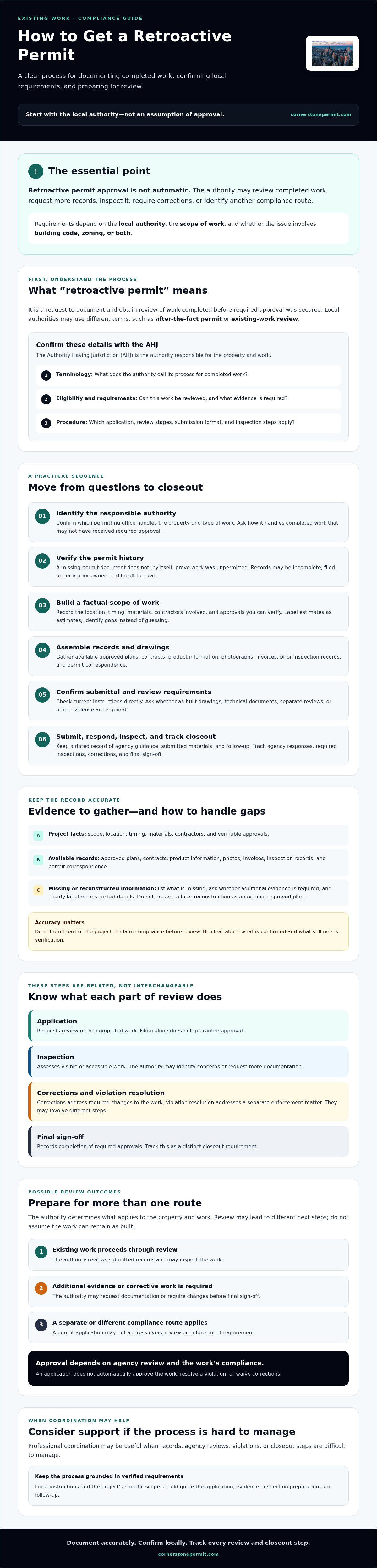
Once you know which authority handles the work and what records are available, move through the application in a controlled sequence. Forms, technical documents, fees, and review order vary by jurisdiction and project. Confirm current instructions directly rather than relying on a general checklist. Keep one project log for submissions, agency comments, deadlines, inspections, and written decisions.
- Confirm the authority and application type. Verify which office reviews the property and scope. Ask which application or process applies to completed work.
- Document existing conditions. Prepare a truthful description of the work and gather supporting records. Distinguish verified information from estimates or reconstructed details.
- Check submittal requirements. Confirm required forms, drawings, evaluations, supporting documents, submission formats, fees, and review sequence. Ask whether technical materials must be prepared or reviewed by an appropriately qualified professional.
- File and retain a complete copy. Submit materials as directed. Save the application, attachments, receipts, and agency correspondence together, and record the submission date and any stated review requirements.
- Respond to comments and coordinate inspections. Log each agency comment, your response, and any revised materials. Schedule inspections as instructed and record results, requested corrections, and follow-up actions.
- Confirm closeout in writing. Check whether permit approval, violation resolution, inspection sign-off, or occupancy records have separate completion requirements. Retain written confirmation of each applicable disposition.
Prepare and submit a complete application
Before filing, compare your application package with the authority’s current instructions. Include the requested documents, describe the work accurately, and disclose known gaps rather than implying missing information exists. If drawings or technical evaluations are required, coordinate them with appropriately qualified professionals. Preserve copies of every version so you can identify exactly what the authority reviewed.
Respond to review comments and complete closeout
Address comments individually, following the agency’s directions for revisions and resubmission. If an inspection identifies outstanding items, document each one and confirm the required next step before treating the matter as complete. A permit record may not, by itself, close a related violation or occupancy requirement. Verify the status of each applicable file with the responsible office.
A consistent log turns how to get a retroactive permit into a sequence of documented actions, while leaving decisions with the authority. For help coordinating permit applications and compliance steps, explore building permit and violation resolution support.
When Permit Expediting Can Help Resolve a Retroactive Permit Issue
Professional coordination can be useful when a project has incomplete records, multiple agency reviews, an open violation, or separate inspection and closeout requirements. A permit professional can help organize the application process, coordinate documents, track agency comments, and follow up on outstanding steps. This support can clarify responsibilities and next actions, but it can’t guarantee approval or replace the professionals responsible for design, construction, inspections, or legal advice.
If you’re assessing how to get a retroactive permit, define the scope of support before work begins. Ask what will be coordinated, what remains the property owner’s or another professional’s responsibility, and which decisions rest solely with the authority.
What should you ask a permit professional?
Clarify whether the engagement includes application preparation, agency communication, document coordination, review-comment tracking, inspection scheduling, or closeout follow-up. Establish who supplies technical drawings, evaluates building conditions, performs required corrections, and responds to legal questions. Ask for a clear account of dependencies, assigned responsibilities, and unresolved approval risks so procedural support isn’t mistaken for a technical or legal determination.
How Cornerstone Permit Company supports permit and compliance processes
Cornerstone Permit Company coordinates building permit applications and related regulatory processes, including building violation resolution, inspections, certificates of occupancy, and building-code consulting. Its role is administrative and process-focused: organizing permit and compliance steps and supporting agency coordination. The company doesn’t provide architectural design, general contracting, or legal representation. The authority retains control over review, required corrections, and final decisions.
Before proceeding, confirm which services align with the project’s needs and which work must be handled by other qualified professionals. A defined division of responsibilities can help keep the application, agency responses, and closeout tasks organized without implying a particular outcome.
Discuss your permit and compliance needs to identify appropriate coordination support for your project.
Move Forward With a Clear Compliance Plan
Bringing completed work into review starts with confirming the authority’s process, documenting existing conditions accurately, and checking which records and technical materials it requires. Keep application review, inspections, any violation response, and final closeout distinct. A retroactive permit request doesn’t guarantee approval. The authority may require further documentation or corrections.
Understanding how to get a retroactive permit means preparing for review and responding to agency direction. Track submissions, comments, inspections, and written decisions so each requirement has a clear next step. When records or multiple compliance processes are difficult to coordinate, administrative support may help keep the work organized without replacing the authority’s judgment or guaranteeing an outcome.
Founded in 2014, Cornerstone Permit Company is a Certified Minority Business Enterprise that supports permit application and regulatory-process management, building violation resolution, inspections, and code-compliance consulting. Discuss your permit and compliance needs to identify appropriate next steps for your project. A careful, well-documented approach can help you pursue a compliant path forward.
Frequently Asked Questions
Can you get a building permit after work is completed?
Sometimes, but the process depends on the authority responsible for the property and the type of work. Some jurisdictions provide a way to submit completed work for review, while others may require a different compliance process. Check the property’s permit history, then ask the permitting office which application applies. The authority may request supporting records, an inspection, or corrections before deciding whether the work can be approved.
Is a retroactive permit guaranteed to be approved?
No. Filing an application requests review; it doesn’t guarantee approval or prevent enforcement. The authority evaluates the submitted information and may identify missing documentation, require an inspection, or direct corrective work. The outcome depends on the work, applicable requirements, and the agency’s review. Confirm the process with the responsible authority and account for the possibility that the work may need changes or may not qualify for approval as submitted.
What happens if work was completed without a required permit?
The authority may require the work to be documented and reviewed, inspect the property, or request corrections. If an enforcement matter exists, you may need to address it separately from the permit application. Procedures vary by jurisdiction and project. Check for notices, citations, or orders, and confirm response and closeout requirements with the responsible agency. Don’t assume that applying for a permit resolves an existing violation.
How do I apply for a retroactive building permit?
To understand how to get a retroactive permit, identify the authority responsible for the property and confirm its current process for completed work. Gather available plans, photographs, contracts, inspection records, and other project information. Ask which forms and technical documents are required, then submit a complete, accurate application. Track agency comments, responses, inspections, and written decisions. The authority will determine whether further review, corrections, or separate enforcement steps apply.
Can an inspector require completed work to be exposed?
An inspector or permitting authority may require access to concealed work when needed for review, but requirements depend on the jurisdiction, project, and conditions being assessed. Don’t assume that walls or other finishes must always be opened, or that they won’t need to be. Ask the authority what inspection access or evidence it requires before arranging work. Follow its instructions and document the inspection result, requested corrections, and subsequent approvals.
Do I need as-built drawings for a retroactive permit?
Not in every case. Whether as-built drawings or other technical documents are required depends on the authority, the work’s scope, and available records. Ask the permitting office what it expects before commissioning drawings, and clarify any required format or professional qualifications. If existing plans don’t accurately show completed conditions, identify the discrepancy. Keep original documents intact and label reconstructed or updated information clearly rather than presenting it as an original approved plan.
How long does a retroactive permit process take?
There’s no reliable universal timeframe. Processing depends on the authority’s procedures, the completeness of the application, review requirements, agency workload, inspection scheduling, and whether more documentation or corrections are needed. Ask the responsible office about its current review steps and how it communicates deadlines or requests. A project log can help track submissions, comments, inspections, and responses, but it can’t control agency timing or guarantee a completion date.
Will a retroactive permit automatically clear a building violation?
No. A permit application and a violation or enforcement matter may be separate processes, handled through different steps or agency records. Permit approval alone may not close a citation, order, or inspection issue. Ask the agency responsible for the violation what documentation, corrective actions, inspections, and written closeout it requires. Keep confirmation for both the permit and enforcement matter, and verify whether any occupancy-related approval must also be completed.