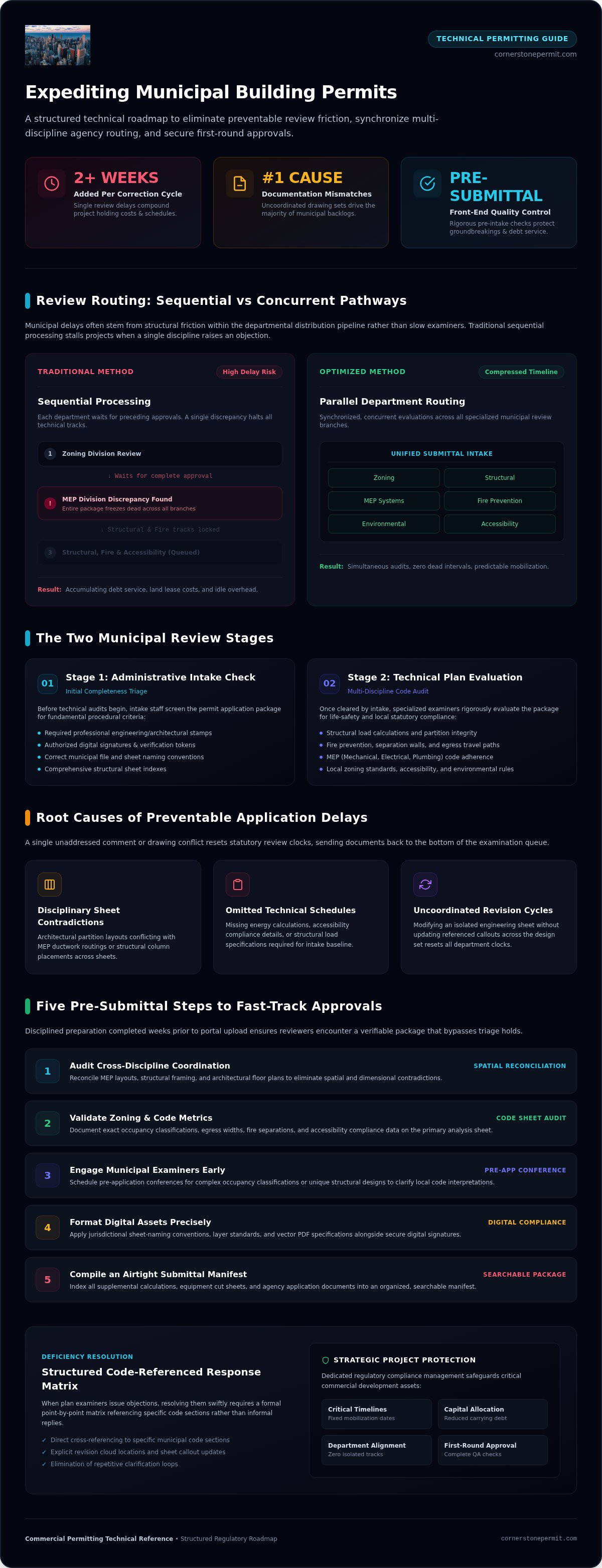
A single correction cycle often adds two or more weeks to a construction timeline, and documentation mismatches remain the primary driver of preventable municipal backlogs. Mastering how to expedite a building permit does not depend on administrative shortcuts or informal favors; it demands rigorous front-end technical precision before drawings ever reach the intake counter.
Every commercial developer and builder knows the operational frustration of disjointed communication between zoning, structural, MEP, and fire department examiners. When applications stall in sequential review queues, project financing costs accumulate and scheduled groundbreakings slip. You can bypass this friction. In this guide, you will learn the systematic strategies experienced project leaders deploy to eliminate review delays, orchestrate concurrent department workflows, and secure first-round approvals without costly revisions.
From pre-submittal quality control to proactive agency management, here is your actionable roadmap to establishing predictable mobilization dates backed by structured regulatory oversight.
Key Takeaways
- Discover how to expedite a building permit by executing thorough cross-discipline quality control before submitting application packages.
- Identify the core root causes of municipal review bottlenecks to prevent avoidable triage rejections and administrative delays.
- Map concurrent submission pathways across building, zoning, environmental, and fire authorities to eliminate sequential wait times.
- Build a structured code-referenced response matrix that resolves plan examiner comments swiftly during revision cycles.
- Leverage dedicated regulatory compliance consulting to protect critical development timelines, capital allocation, and mobilization schedules.
Understanding Municipal Plan Review Bottlenecks and Review Cycles
Municipal plan review workflows rarely operate along a predictable, straight line. Securing commercial authorizations requires passing through distinct administrative gates, starting with intake verification and concluding with multi-discipline technical reviews. Understanding how to expedite a building permit begins with recognizing that delay isn't typically caused by slow examiners, but by structural friction within the departmental distribution pipeline itself.
Most local jurisdictions split filings across specialized review branches: structural, zoning, MEP (mechanical, electrical, plumbing), fire prevention, environmental compliance, and accessibility. In traditional sequential processing, the zoning division must fully approve a file before MEP examiners even download the sheets. When one reviewer discovers a discrepancy, the file stops dead. Synchronized, concurrent evaluations eliminate these dead intervals, yet achieving true parallel processing requires submitting submittal packages tailored specifically to pass initial intake scrutiny.
Carrying debt service, land lease obligations, and site overhead while waiting on agency approvals erodes commercial project margins quickly. Every idle week awaiting approval drains capital without advancing construction milestones.
The Mechanics of Departmental Review Tracks
Intake staff evaluate permit packages through two distinct stages. The administrative check screens for required signatures, professional stamps, correct naming conventions, and structural sheet indexes. Once cleared, the package transitions to substantive technical evaluation, where individual discipline examiners audit for life-safety and local code adherence. Delays multiply when overlapping authorities operate in isolation; if a fire safety examiner demands a revised egress path that alters structural load-bearing partitions, both tracks freeze until the conflict resolves.
Root Causes of Preventable Application Delays
Preventable rejections almost always stem from uncoordinated document sets. When contractors and project owners evaluate how to expedite a building permit, eliminating discrepancies between discipline drawings represents the highest-leverage intervention. Common failure points include:
- Disciplinary sheet contradictions: Architectural plans showing partition layouts that conflict with MEP ductwork routings or structural column placements.
- Omitted technical schedules: Missing energy calculations, accessibility compliance details, or structural load specifications required for baseline intake.
- Uncoordinated revision cycles: Modifying a single engineering sheet during corrections without updating referenced callouts across the full design package, which resets statutory review clocks across all departments.
A single unaddressed comment resets the agency review window, sending documentation back to the bottom of the examination queue. Avoiding this restart requires methodical front-end alignment across every drawing discipline.
Five Pre-Submittal Steps to Fast-Track Permit Approvals
Rigorous pre-submittal quality assurance prevents the administrative rejections that derail commercial project schedules. When trade teams ask how to expedite a building permit, the most effective answer lies in the disciplined preparation completed weeks prior to portal upload. Executing a standardized five-step intake readiness sequence ensures plan reviewers encounter a fully coordinated, verifiable drawing set that moves immediately into technical review.
- Audit cross-discipline coordination: Reconcile MEP layouts, structural framing, and architectural floor plans to eliminate spatial and dimensional contradictions.
- Validate zoning and code metrics: Document exact occupancy classifications, egress widths, fire separations, and accessibility compliance data on the primary code analysis sheet.
- Engage municipal examiners early: Schedule pre-application conferences for complex occupancy classifications or unique structural designs to clarify local interpretations.
- Format digital assets precisely: Apply jurisdictional sheet-naming conventions, layer standards, and vector PDF requirements alongside secure digital signatures.
- Compile an airtight submittal manifest: Index all supplemental calculations, equipment cut sheets, and agency applications into a searchable package.
Conducting Cross-Discipline Drawing Reconciliation
Spatial discrepancies trigger immediate plan examiner objections. Foundations must reflect exact plumbing under-slab penetrations and mechanical sleeve openings before stamping. Electrical service schedules need direct alignment with local utility point-of-connection letters, while life-safety plans must match fire suppression riser diagrams without variance. Before final signing, audit the master drawing index against the physical sheets to confirm every referenced detail, section cut, and schedule exists within the submittal package.
Securing Preliminary Plan Review Determinations
Unconventional construction assemblies demand early regulatory alignment. Engaging plan examiners via formal preliminary reviews establishes binding interpretations on fire-resistance ratings, egress paths, and mixed-occupancy separations before formal lodgment. When project conditions require alternative materials or methods, prepare structured administrative modification requests citing specific performance standards. Incorporating these signed municipal determination memos directly into the plan set stops examiners from flagging pre-negotiated designs during primary reviews.
Standardizing Documentation for Digital Municipal Portals
Digital intake systems reject non-compliant files instantly. Optimize all digital deliverables by embedding searchable vector text, flattened layers, and hyperlinked document bookmarks matching local agency conventions. To streamline intake across multi-jurisdictional portfolios, teams often partner with Cornerstone Permit Company for comprehensive plan review consulting and permit management. Calibrating drawing scales, title blocks, and supporting structural calculations prior to upload secures first-cycle technical clearance and eliminates administrative kickbacks.
Coordinating Parallel Department Routing to Compress Approval Timelines
Sequential municipal reviews create catastrophic schedule drag. When a building department funnels applications through zoning, environmental health, structural, and fire divisions one after another, a single inquiry halts overall momentum. Developers evaluating how to expedite a building permit compress their schedules by transitioning from passive linear processing to synchronized, parallel departmental routing across all authorities having jurisdiction (AHJs).
Concurrent submissions allow separate municipal divisions to evaluate technical drawings at the same time. Rather than waiting for zoning clearance before releasing plans to mechanical or structural examiners, establishing parallel workflows cuts calendar weeks off the standard review cycle.
Mapping Inter-Agency Review Dependencies
Commercial construction scopes interact with multiple regulatory bodies simultaneously. Decoupling independent scopes prevents isolated departmental questions from stalling unrelated technical reviews. Divide submittals into autonomous regulatory tracks wherever municipal frameworks allow:
- Right-of-way and transportation: Lodge Department of Transportation (DOT), curb-cut, and street-use permits independently so off-site logistics clear before site mobilization.
- Civil and site infrastructure: Advance grading, stormwater management, and underground utility clearances ahead of interior tenant buildout reviews.
- Environmental health and safety: Route grease trap approvals, health department food service reviews, and hazardous materials disclosures alongside architectural filings.
Structuring independent tracks ensures that a localized civil clarification won't suspend interior MEP plan examinations.
Managing Active Intake and Status Tracking
Parallel routing demands disciplined administrative management. Automated municipal portals often obscure review progress, making real-time visibility essential. Project managers must maintain detailed tracking logs that record examiner assignment dates, internal target completion deadlines, and division-specific holds.
Active tracking isolates administrative stalls before they turn into compound project delays. If a plumbing examiner raises a code question, immediate outreach resolves the comment without allowing the file to sit dormant on the desk. When reviews exceed published service level agreements, structured communication with branch supervisors keeps the application moving. Maintaining regular, composed contact with agency leads ensures files don't linger unassigned during municipal staffing shortages or peak filing cycles.
Resolving Plan Review Objections and Deficiencies Efficiently
Receiving municipal plan review comments is standard in commercial development, but the response methodology determines whether a project maintains momentum or enters protracted review limbo. Understanding how to expedite a building permit through correction cycles requires treating plan examiners as technical collaborators rather than bureaucratic obstacles. When trade teams triage, address, and document code resolutions methodically, second-round approvals become the standard outcome.
Structuring an Examiner-Focused Response Matrix
A structured comment-response matrix eliminates ambiguity for examiners who handle dozens of open files simultaneously. Build a dedicated tabular document that transcribes every agency comment verbatim. Directly beside each note, provide a concise explanation of the design adjustment, reference the exact revised drawing sheet number, call out specific detail clouds, and cite applicable building code sections. Providing unambiguous documentation allows the examiner to verify compliance quickly without searching through unindexed plan sets.
Coordinating Unified Revision Packages
Fragmented re-submissions cause compounding administrative friction. Submitting revised plumbing sheets while electrical drawings remain in revision disrupts municipal file tracking and triggers conflicting review cycles. Design teams must hold all documentation until every discipline completes its updates. Cross-check each modification across adjacent trades to ensure a mechanical duct relocation doesn't penetrate an unrated partition or breach structural clearances, and confirm all revised sheets carry updated revision dates and professional seals.
Conducting Productive Examiner Clarification Meetings
When separate departments issue conflicting requirements, schedule a targeted administrative clarification meeting to resolve the impasse. Prepare code-compliant alternative pathways supported by recognized standard exceptions before entering the session. Once the examiner agrees to a path forward, document the exact resolution in formal meeting minutes and submit them into the official municipal record.
To streamline complex correction cycles and secure fast-track signoffs, partner with Cornerstone Permit Company for building code consulting and permit management.
Leveraging Professional Permit Expediting Services for Complex Projects
Managing regulatory risk requires strategic resource allocation. When developers evaluate how to expedite a building permit across complex commercial assets, delegating municipal coordination to internal project staff often strains operational capacity. True permit expediting extends far beyond basic document delivery; it functions as a disciplined consulting discipline that protects project pro formas, capital deployment, and delivery milestones.
Distinguishing between administrative couriers and comprehensive regulatory consultants is essential. Basic runners physically or digitally deliver files without auditing content. Strategic regulatory partners, conversely, provide pre-intake code diagnostics, identify inter-agency jurisdictional friction points, and actively steer applications through municipal review divisions.
Evaluating Project Complexity and Resource Allocation
Aggressive project milestones and dense multi-department requirements require dedicated regulatory oversight. Architects, structural engineers, and general contractors deliver vital technical work, but diverting their time toward administrative municipal follow-up misallocates specialized project resources. When projects involve strict tenant delivery commitments, complicated code interpretations, or multi-phased occupancies, carrying costs accumulate rapidly during downtime. Investing in proactive regulatory management safeguards the master construction schedule against avoidable agency backlogs.
Core Capabilities of Comprehensive Regulatory Management
Experienced regulatory consultants safeguard capital by conducting rigorous pre-submittal quality control. Specialists fluent in commercial building codes, ADA accessibility standards, and departmental procedures audit drawing sets before municipal intake to eliminate preventable rejections. Their operational reach spans from preliminary architectural review through final departmental inspections and Certificate of Occupancy signoff.
Integrating regulatory management directly into the critical path schedule establishes predictable construction mobilization dates. Active agency tracking synchronizes trade procurement, site logistics, and utility connections with realistic municipal release windows, ensuring projects advance cleanly into field operations.
Discover how Cornerstone Permit Company coordinates seamless multi-agency approvals across complex commercial portfolios, protecting mobilization timelines through disciplined regulatory execution.
Establish Predictable Approval Timelines for Your Commercial Pipeline
Municipal review delays don't have to dictate your construction milestones. Mastering how to expedite a building permit requires shifting from reactive corrections to disciplined front-end quality control, coordinated parallel agency routing, and structured comment-response documentation. When multidisciplinary drawings align seamlessly before submission, examiners move applications through technical channels without costly restarts.
Navigating multi-agency jurisdictions calls for seasoned regulatory precision. Partner with Cornerstone Permit Company to accelerate your commercial plan reviews and safeguard your construction timeline. With deep technical consulting spanning commercial building codes, ADA regulations, sign permits, and Certificate of Occupancy signoffs, our team manages complex approvals across national jurisdictions so you can break ground on schedule with total confidence.
Frequently Asked Questions
Can you legally pay a municipal building department to expedite a permit?
Yes, many municipal building departments offer formal expedited or premium review programs that legally compress review cycles for an additional administrative fee. These agency programs typically involve overtime reviews by internal examiners or certified third-party plan review providers authorized by the jurisdiction. However, paying municipal fees does not lower technical compliance standards. Packages must still comply fully with applicable building codes, or examiners will reject them despite the expedited fee.
What is the difference between a permit expediter and a building code consultant?
A basic permit expediter primarily handles the administrative tracking, submission routing, and courier tasks required to move paperwork through municipal portals. In contrast, a building code consultant provides in-depth technical analysis before submission, diagnosing code vulnerabilities, egress discrepancies, and accessibility requirements. Strategic firms integrate both disciplines, combining technical code mastery with proactive multi-agency navigation to resolve objections before they trigger review delays.
How much time does professional permit expediting typically save on commercial projects?
Professional regulatory management typically reduces overall approval schedules by several weeks or even months, depending on project scale and agency backlogs. When evaluating how to expedite a building permit, experienced consultants compress timelines by running concurrent department reviews and eliminating repeated correction cycles. Addressing technical discrepancies before submission and resolving examiner comments within single revision cycles prevents projects from sitting in queue restarts.
What documents are most commonly missing during initial building permit intake?
Administrative intake delays are most frequently triggered by missing energy code calculations, incomplete structural design criteria, and uncoordinated architectural site plans. Building departments also routinely reject submissions lacking valid digital signatures, complete professional seals, tenant identification affidavits, or detailed accessibility path-of-travel diagrams. Compiling an exhaustive submittal manifest before lodging the application prevents these administrative completeness rejections at the intake counter.
How do concurrent plan reviews differ from sequential departmental reviews?
Sequential reviews require each municipal department to conclude its evaluation before the file transfers to the next division, creating substantial calendar drag. In contrast, concurrent reviews distribute digital drawing sets to zoning, structural, fire, and MEP examiners simultaneously. This parallel routing enables departments to review the project at the same time, significantly compressing the total timeline and revealing cross-discipline issues early in the review cycle.
What should a contractor do if two municipal review departments issue conflicting comments?
When departmental requirements clash, request a joint administrative clarification meeting with both plan examiners and their respective supervisors. Don't attempt piecemeal revisions that satisfy one division while violating another. Present a unified, code-supported compliance alternative referencing recognized national code exceptions, and immediately record the mutually agreed-upon solution in formal meeting minutes submitted into the official permit record.
Does having a complete plan set guarantee first-round building permit approval?
A complete plan set doesn't guarantee immediate first-round approval, but it significantly reduces the scope and duration of revision cycles. Municipal plan examiners frequently exercise local discretionary interpretation on nuanced code sections, even when drawings meet baseline intake standards. Knowing how to expedite a building permit involves pairing technical submittal thoroughness with structured, rapid comment responses that resolve administrative inquiries in a single turnaround.