A food establishment license is rarely the only approval between a business and opening day. Food establishment licensing depends on what you serve, how you operate, and which authorities oversee the premises. Treating it as a single application can leave requirements out of sequence or overlooked.
Start by defining the operation and identifying the approvals that may apply. Requirements vary by jurisdiction and establishment type, and licensing tasks can depend on premises, construction, inspections, and operational readiness. Mapping these dependencies early gives you a clearer basis for planning an opening schedule.
This guide explains how business activities affect licensing requirements, how to compare self-managed applications with professional support, and how to coordinate submissions with opening milestones. Cornerstone Permit Company manages food-service and liquor licensing applications and related regulatory coordination, helping businesses organize licensing within a broader project workflow. You’ll also learn how to track compliance responsibilities and keep application tasks aligned with your plans.
Key Takeaways
- Map food establishment licensing requirements to your operation, facility, and applicable authorities rather than assuming one approval covers every need.
- Use your service model, menu, food handling, and facility use to identify requirements that may affect the application process.
- Compare self-managed filing with professional coordination by weighing internal capacity, application complexity, project dependencies, and follow-up workload.
- Build licensing into your opening plan, from defining operations and assembling records to submitting applications and tracking agency responses.
- Cornerstone Permit Company coordinates food-service and liquor licensing applications with related compliance and opening activities.
What food establishment licensing covers, and why it is more than one application
Food establishment licensing is the set of approvals and registrations that applies to a particular food operation under the authorities responsible for it. There is no single nationwide license that automatically covers every business. Requirements depend on what the business does, how its facility is used, and how oversight is divided among relevant agencies.
Licensing supports oversight of food preparation, handling, storage, and sales. These activities connect to broader food safety principles, but the approvals required to operate are specific to the business and its jurisdiction. Include licensing in your opening plan alongside other regulatory steps, not as a substitute for them.
Which food businesses may need licensing?
Different operating models can trigger different requirements. A restaurant may prepare and serve meals on site; a café may have a more limited menu or service model; a caterer may prepare food for off-site events; and a food retailer may primarily store and sell packaged goods. Preparation, service, storage, and sales all help define the operation regulators assess.
Before filing, describe the planned activities and facility as specifically as possible. Then identify the authorities responsible for those activities and review their current application instructions. Processes and requirements can vary across jurisdictions, so don’t assume that another business with a similar name or menu follows the same pathway.
How licensing differs from permits and other approvals
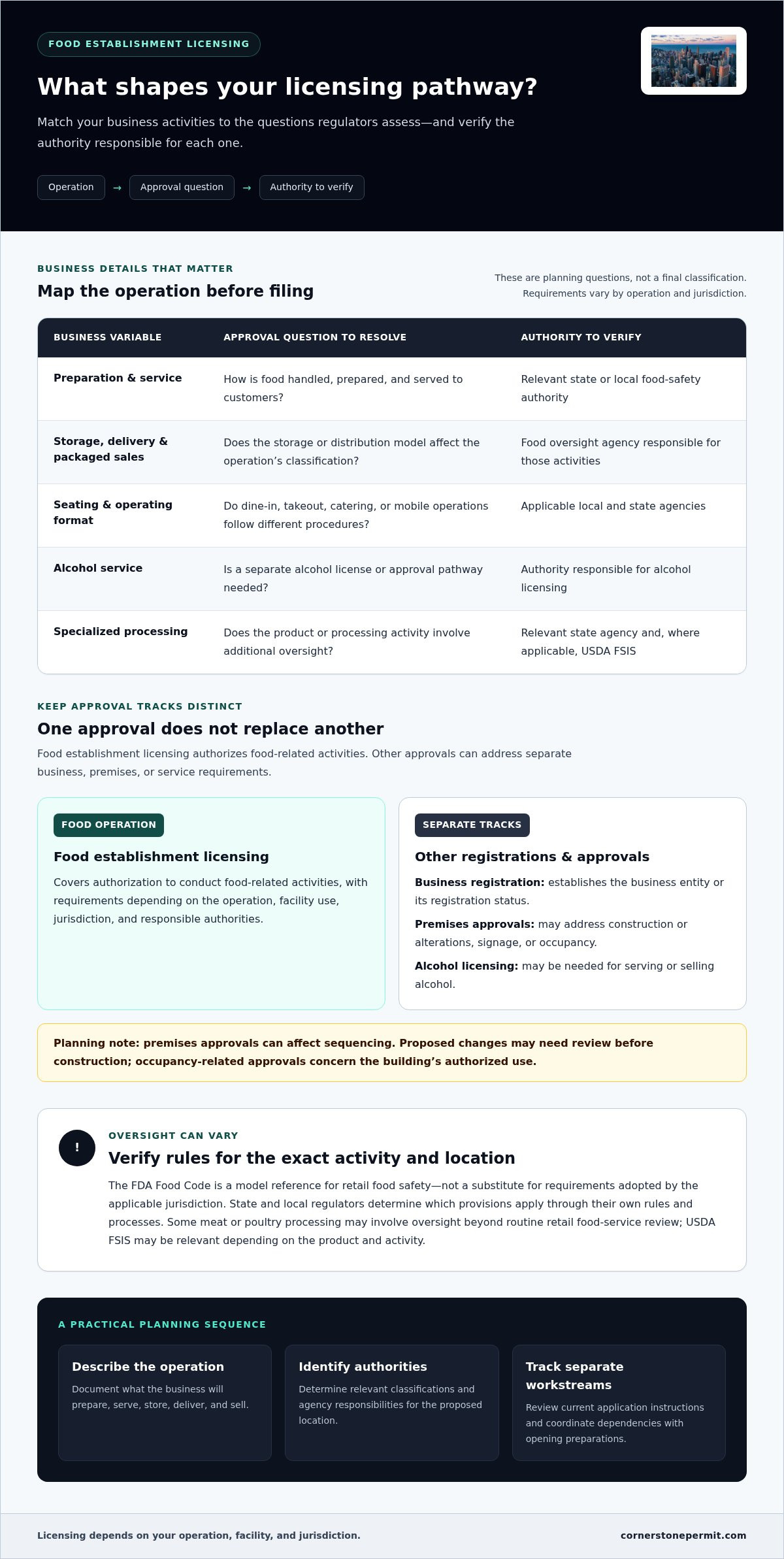
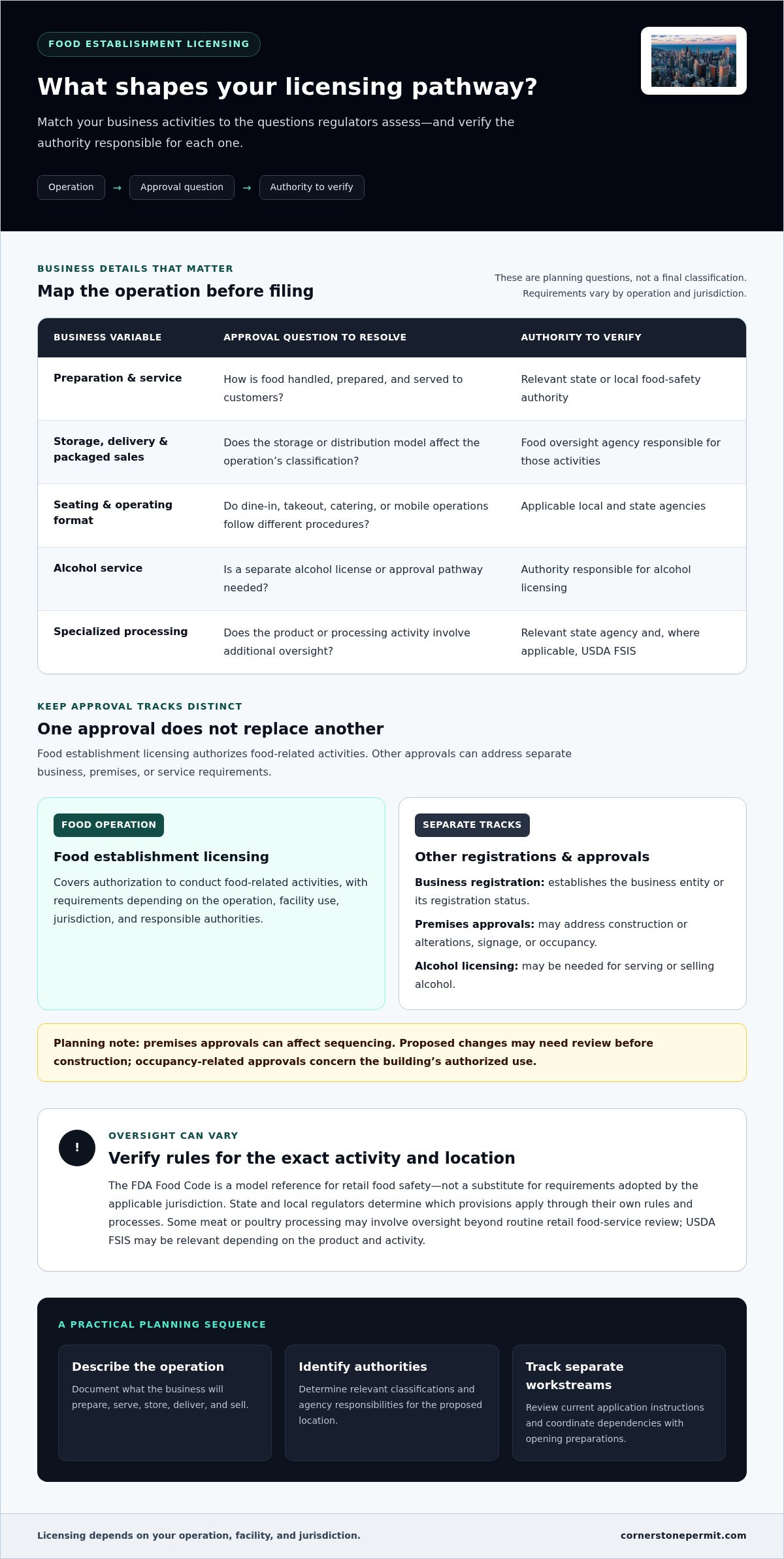
Establishment licensing addresses authorization to conduct food-related activities. It is distinct from business registration, which establishes the business entity or its registration status, and from approvals tied to the premises. Depending on the project and applicable rules, separate steps may address construction or alterations, signage, or occupancy. One approval should not be assumed to satisfy another.
Premises approvals can affect the sequence of work: proposed changes may need review before construction, while occupancy-related approvals concern the building’s authorized use. For an overview of that separate process, see the commercial building permit guide.
Alcohol service adds another licensing layer. A business planning to serve or sell alcohol may need a liquor license in addition to food-service approvals, and the application process and responsible authority may differ. Track these as distinct workstreams so you can identify dependencies, assign responsibilities, and coordinate approvals with opening preparations.
How food establishment licensing requirements vary by operation and jurisdiction
Food establishment licensing requirements depend on both the operation and how oversight is divided. State and local agencies may have different roles, and the same business description can prompt different application questions across jurisdictions. Document what the business will prepare, serve, store, deliver, and sell, then determine the relevant classifications and agency responsibilities for the proposed location.
Which business details shape the licensing pathway?
Menu and service format are useful starting points, but they are not the whole picture. Seating, takeout or delivery, packaged-product sales, food storage, and alcohol service can each affect which approvals or reviews may be relevant. Treat these as planning variables, not proof that a particular license or agency applies. The FDA’s guide to federal food business requirements covers federal considerations, including food facility registration, while applicability depends on the operation.
| Business variable | Approval question to resolve | Authority to verify |
|---|---|---|
| Preparation and service | How is food handled, prepared, and served to customers? | Relevant state or local food-safety authority |
| Storage, delivery, and packaged sales | Does the operation’s storage or distribution model affect its classification? | Food oversight agency responsible for those activities |
| Seating and operating format | Do dine-in, takeout, catering, or mobile operations follow different procedures? | Applicable local and state agencies |
| Alcohol service | Is a separate alcohol license or approval pathway needed? | Authority responsible for alcohol licensing |
| Specialized processing | Does the product or processing activity involve additional oversight? | Relevant state agency and, where applicable, USDA FSIS |
When can specialized food-safety oversight apply?
The FDA Food Code is a model reference for retail food safety, not a substitute for requirements adopted by the applicable jurisdiction. State and local regulators determine which provisions apply through their own rules and processes. Specialized activities, including certain meat or poultry processing, may involve oversight beyond routine retail food-service review. USDA’s Food Safety and Inspection Service (FSIS) may be relevant to some such operations, depending on the product and activity.
Use the table to frame questions, not to assume a final classification. Determine the responsible authority, applicable rules, forms, and any additional reviews for the exact operation. Cornerstone’s licensing support coordinates food-service and liquor licensing applications as part of the broader opening workflow.
Self-managed filing or licensing support: how to compare the approaches
Choosing how to manage food establishment licensing depends on more than the number of forms. Consider how many approvals are involved, whether applications depend on premises or construction milestones, who will gather records, and who can monitor agency follow-up while the business prepares to open.
Application coordination can organize submissions and follow-up, but it cannot determine an agency’s decision or guarantee approval. The business remains responsible for its operations and for the accuracy of information submitted. A coordinated process can make administrative tasks, deadlines, and outstanding requests easier to track.
When can an owner manage the process directly?
Direct filing may suit a straightforward operation when requirements are clear and the owner or staff have capacity to prepare records, complete forms, track correspondence, and respond to requests. Use the responsible agency’s current instructions as the filing reference, since forms and procedures can change. Owners remain accountable for accurate applications and for meeting applicable operational requirements.
The FDA’s guide to federal, state, and local requirements provides a useful overview of regulatory layers for starting a food business. It can help frame your research, but it does not replace the instructions of agencies responsible for the specific operation.
When can professional licensing coordination add value?
Support can be useful when an operation involves several applications, multiple decision points, or dependencies on construction, premises approvals, or opening readiness. It can also help when internal staff are focused on launch operations and have limited capacity for document coordination and agency follow-up.
Professional coordination can organize application materials, maintain a record of submissions and responses, track outstanding requests, and align licensing tasks with related approvals. Cornerstone Permit Company provides food-service and liquor licensing support as part of this process-management approach. The business supplies accurate operational information and remains responsible for its compliance obligations; agencies retain authority over reviews and decisions.
- Self-managed filing: The owner controls submissions and follow-up, provided internal time and administrative capacity are available.
- Managed coordination: Application steps and related compliance tasks are organized alongside other project dependencies, while agency decisions remain outside the coordinator’s control.
Compare the approaches against the actual workload, not just the number of forms. A single application may require sustained document preparation and follow-up, while multiple approvals may be manageable when responsibilities and dependencies are clearly assigned.
Prepare a food establishment licensing plan around opening milestones
Build licensing into the opening schedule rather than treating it as a final administrative task. A practical sequence is to define the planned operation, identify the responsible authorities, organize records, submit applications, and monitor agency responses. The exact forms, inspections, and prerequisites depend on the jurisdiction and business activities, so determine the applicable process before setting internal milestones.
Premises readiness matters. An application or review may depend on facility details, while construction approvals and occupancy steps can affect when the space is ready for operational review. Map these dependencies against the planned opening date. Do not assume construction completion and licensing approval will occur in a fixed order everywhere.
What information should operators organize before filing?
Prepare a working file with relevant business and ownership details, premises information, menu or product descriptions, and an outline of how food will be prepared, handled, stored, served, or sold. These are planning categories, not a universal list of required documents. The authority responsible for the operation determines which forms and supporting records apply.
A document-readiness matrix helps assign work without implying that every item is required:
- Business and ownership: Identify information that may be needed to describe the applicant and responsible parties.
- Premises: Gather available facility details and track related construction or occupancy milestones.
- Menu and products: Record planned offerings and relevant handling or storage activities.
- Operating model: Summarize service, delivery, packaged sales, and other planned activities.
- Application tracking: Maintain one record of submissions, agency communications, outstanding items, and assigned owners.
How can operators manage review and follow-up?
After submission, record each application’s status, agency contact or reference information, questions received, the person responsible for responding, and the response date or next follow-up action. Keep the record current as premises work and opening preparations progress. This makes dependencies visible and helps prevent agency requests from being lost among project tasks.
If information is incomplete or inconsistent, address it promptly through the applicable agency process and keep the response with the application record. Coordinate updates across related filings so details remain aligned. Cornerstone’s licensing and permit support can help organize application management alongside opening and permit-related work.
How Cornerstone supports food establishment licensing and opening coordination
Food establishment licensing involves more than completing forms. Applications may need to align with the planned operation, premises status, related permits, and opening milestones. Cornerstone Permit Company manages food-service and liquor licensing applications and related compliance coordination, helping operators organize those administrative workstreams as project details develop.
Founded in 2014, Cornerstone is a Certified Minority Business Enterprise. The company coordinates application processes and related regulatory tasks; licensing authorities review applications and determine approvals.
What application-management support can cover
Application coordination helps establish a clear record of what has been submitted, which agency requests remain open, and who is responsible for the next administrative step. Depending on the project, this can include organizing application materials, monitoring agency communications, and coordinating follow-up across food-service and liquor licensing workstreams.
These tasks can be managed alongside applicable permits and opening milestones rather than in isolation. For example, a change in premises status or planned operations may affect information used across related applications. Coordinated tracking keeps those dependencies visible, while the business remains responsible for providing accurate project and operating details.
Cornerstone’s role is process management and regulatory coordination. The company does not provide legal representation, make agency decisions, or promise approval or processing speed.
Choose a clear next step for your licensing plan
To frame your project, summarize the type of food operation, current premises status, planned services, whether alcohol service is included, and target opening. Note any construction or permit work that may affect facility readiness. These details help define the approvals and dependencies to organize.
Food establishment licensing can then be coordinated as part of the broader opening plan, with application tasks and follow-up mapped to the project’s needs. Discuss food establishment licensing support for your project with Cornerstone.
Set Your Licensing Plan in Motion
Food establishment licensing is best managed as part of opening readiness, not as a standalone filing. Requirements depend on the operation and applicable authorities, so define business activities, identify relevant approvals, and align application tasks with premises and opening milestones.
A clear workflow also makes the choice between self-managed filing and licensing support more practical. Owners can manage applications when they have the capacity to prepare records and track follow-up; coordinated support can help organize multiple submissions and dependencies. In either case, agencies make approval decisions, and accurate project information remains essential.
Cornerstone Permit Company provides food-service and liquor licensing support with permit and compliance coordination. Founded in 2014 and certified as a Minority Business Enterprise, Cornerstone helps organize licensing applications within commercial project workflows. Discuss food establishment licensing support for your project and take a structured next step toward opening with responsibilities clearly mapped.
Frequently Asked Questions
Is a food establishment license required to open a restaurant?
A restaurant may need food-related operating approval before it begins serving, but the exact requirement depends on its location, activities, and applicable rules. Requirements can differ based on food preparation, service, storage, and facility use. Identify the authorities responsible for the proposed operation and follow their current instructions to determine which applications, reviews, or inspections apply before setting an opening plan.
What is the difference between a food establishment license and a food service permit?
The terms can describe similar operating approvals, but their meanings and use vary by jurisdiction. One authority may call its authorization a license, while another may use permit or registration. Don’t rely on the label alone. Check the agency’s definition, what activities the approval covers, and whether separate premises, construction, occupancy, or other approvals apply to the business.
How do I find out which food establishment licenses my business needs?
Start by documenting what the business will prepare, serve, store, deliver, and sell, along with its premises and service model. Then identify the state and local authorities responsible for those activities and consult their current requirements. Food establishment licensing can involve more than one approval, so determine classifications, forms, supporting records, and applicable review steps with the responsible agencies.
How long does food establishment licensing take?
There is no single timeline that applies to every application. Review duration can depend on the jurisdiction, type of operation, completeness of the submission, agency questions, and premises or inspection dependencies. Review current guidance from the responsible authority and build time for follow-up into the opening plan. Avoid treating an estimated review period as a guaranteed approval date.
Can I apply for a food establishment license before my location is ready?
Some application steps may be possible before a premises is fully ready, but the applicable authority determines when it will accept an application and what information or inspections are needed. Organize business and operating details early, then determine how premises readiness, construction work, and occupancy approvals affect review. Align these tasks with the project schedule so prerequisites and dependencies remain visible.
How much does food establishment licensing cost?
Fees vary by jurisdiction and may depend on the approval type, operation, or review involved. There is no reliable nationwide price that applies to every food business. Consult the current fee schedule published by each relevant authority, and distinguish agency fees from other project expenses. Determine which applications apply before budgeting, since required approvals depend on the operation and premises.
Can a licensing consultant guarantee that a food establishment license will be approved?
No. A consultant can help organize application materials, coordinate submissions, monitor agency requests, and manage administrative follow-up, but approval decisions belong to the responsible authorities. Cornerstone Permit Company provides food-service and liquor licensing support with related compliance coordination. This process-management support can help keep tasks organized, but it cannot guarantee an agency decision or a particular timeline.
Does serving alcohol require a separate license from food establishment licensing?
Alcohol service may require a separate liquor license in addition to food-service approvals. The responsible authority, application process, and requirements depend on the jurisdiction and planned service. If the business intends to serve or sell alcohol, include that activity in the opening plan from the outset and determine the applicable licensing pathway with the authority responsible for alcohol approvals.