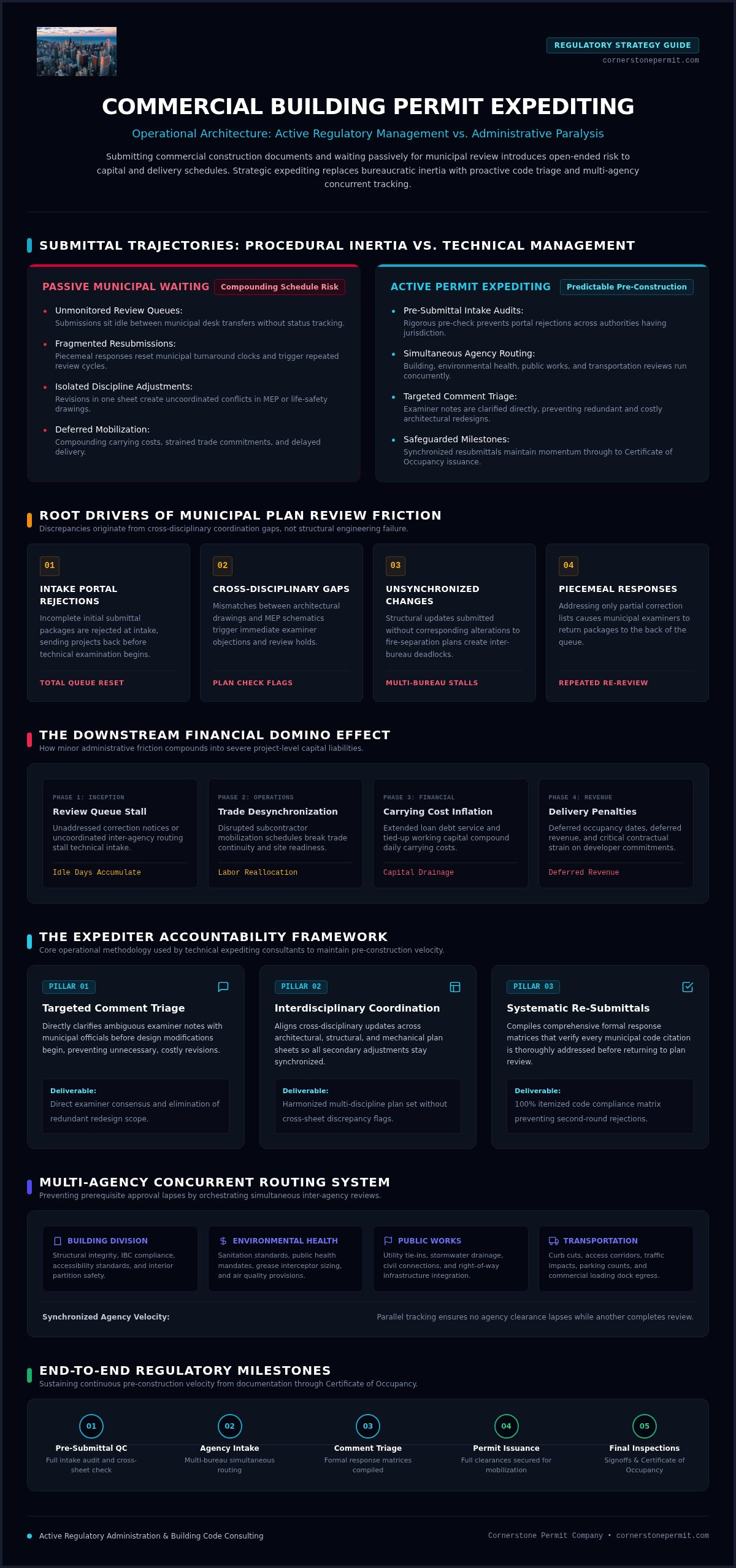
Submitting commercial construction documents and waiting passively for municipal review isn't a project strategy; it's an open-ended risk to your capital and delivery calendar. For general contractors and developers, unpredictable review queues, conflicting correction notices, and uncoordinated municipal departments routinely stall projects before mobilization can even begin. Professional building permit expediting replaces this administrative paralysis with technical rigor, converting an opaque regulatory system into an actively managed, predictable pre-construction phase.
Every commercial stakeholder understands that stalled approvals trigger compounding downstream costs, from disrupted subcontractor commitments to deferred revenue. This comprehensive guide details how dedicated commercial permit expediting accelerates agency signoffs, resolves examiner objections before they derail schedules, and safeguards mission-critical construction milestones. You will examine the operational mechanics of multi-department concurrent tracking, proactive code triage, and the precise standards required to select a regulatory consulting partner capable of maintaining continuous momentum through the final Certificate of Occupancy.
Key Takeaways
- Professional commercial building permit expediting functions as active regulatory management, aligning architectural design teams with municipal examiners to eliminate procedural bottlenecks.
- Unresolved correction notices and uncoordinated departmental re-reviews compound capital carrying costs, turning minor technical discrepancies into severe schedule liabilities.
- Rigorous pre-submittal quality control and simultaneous multi-agency routing prevent submission rejections across all relevant municipal authorities having jurisdiction.
- Evaluating an expediting firm demands verifying technical plan examination expertise and code consulting proficiency, not just standard administrative filing capabilities.
- End-to-end regulatory coordination maintains pre-construction velocity and secures critical milestones through final inspections and Certificate of Occupancy issuance.
Understanding Building Permit Expediting in Commercial Construction
Commercial construction demands the precise synchronization of architectural design with rigid, multi-layered regulatory frameworks. Professional building permit expediting operates as the structured technical administration of these municipal approvals, functioning far beyond passive document filing or courier tasks. By systematically auditing documentation before formal intake, specialized consultants bridge the technical gap between private design teams and municipal plan examiners. Commercial assets must satisfy intersecting zoning classifications, fire and life-safety codes, public health mandates, and accessibility standards. In understanding building permit expediting across complex commercial portfolios, project leaders recognize that rigorous regulatory oversight resolves procedural roadblocks before plan check queues can stall pre-construction schedules.
The Scope of Commercial Permit Management
Standard submittal methods treat municipal compliance as a transactional administrative task, which frequently leaves technical packages vulnerable to bureaucratic inertia. Strategic permit management, however, applies comprehensive regulatory administration and building code consulting across every phase of review. It orchestrates concurrent multi-agency routing through building divisions, environmental health boards, public works, and transportation departments. Rather than allowing applications to sit idle between desk transfers, professional expediters track inter-agency reviews simultaneously, verify that prerequisite approvals don't lapse, and maintain momentum from initial document packages through final inspection signoffs.
Key Stakeholders in the Permitting Lifecycle
Securing project clearances requires disciplined alignment among architects, structural and MEP engineers, and general contractors. Expediters serve as the technical communication bridge between these private design entities and municipal plan examiners. When plan examiners issue correction notices, the expediter establishes a structured accountability framework to keep the project moving forward:
- Targeted comment triage: Clarifying ambiguous examiner notes with municipal officials to prevent unnecessary, costly design revisions.
- Interdisciplinary coordination: Aligning cross-disciplinary updates across architectural, structural, and mechanical plan sheets so corrections remain synchronized.
- Systematic re-submittals: Compiling formal response matrices that verify every municipal code citation is thoroughly addressed before returning to plan review.
The Operational Cost of Municipal Plan Review Delays
Evaluating the operational cost of municipal plan review delays requires examining how bureaucratic friction compounds into direct financial loss. Municipal intake portals reject incomplete documentation packages outright, sending projects back to initial intake queues before technical evaluation even begins. Once plans finally enter departmental review, unresolved objections trigger repeated re-examination cycles. These administrative stalls don't merely defer start dates; they disrupt project continuity, tie up working capital, and place delivery commitments under immediate contractual strain.
Primary Drivers of Commercial Permitting Delays
Submittal rejections rarely stem from catastrophic engineering failures; they typically originate from cross-disciplinary oversights and fragmented communication. Discrepancies between architectural layouts and mechanical, electrical, or plumbing (MEP) schematics instantly draw examiner flags. Structural revisions that lack corresponding updates on fire-separation plans create immediate friction across disparate review bureaus. When design teams submit piecemeal responses addressing only a fraction of an examiner's correction sheet, municipal policy routinely returns the entire package to the back of the queue, resetting review turnaround clocks entirely.
Downstream Financial Impacts on Construction Schedules
Permit delays create a domino effect across commercial delivery timelines, converting idle days into tangible financial liabilities:
- Carrying costs and loan debt service: Construction financing accrues interest continuously while teams wait for foundation or core-and-shell authorizations, eroding project contingencies.
- Contractor remobilization charges: Stalled start authorizations disrupt subcontractor commitments, leading to trade stacking, schedule conflicts, and standby penalties.
- Lease covenant defaults: Delayed commercial tenant improvements push planned opening dates past agreed deadlines, which can trigger rent concessions, liquidated damages, or lease cancellation clauses.
Mitigating these balance-sheet exposures requires proactive technical triage rather than passive waiting. Implementing dedicated building permit expediting ensures submittals undergo comprehensive quality-control reviews before filing, closing coordination gaps and protecting the pre-construction baseline.
Evaluation Criteria for Commercial Building Permit Expediting Services
Selecting an expediting partner requires a clear distinction between administrative couriers and consultative regulatory strategists. While basic messengers simply submit documents, an effective consulting firm audits packages against technical standards to eliminate revision cycles. Managing modern commercial builds demands proven expertise across light industrial facilities, multi-floor corporate offices, and complex retail spaces. When evaluating external partners for commercial building permit expediting, general contractors and developers must assess whether a firm provides substantive building code consulting, accessibility compliance oversight, and disciplined plan check triage.
Technical Competence Versus Basic Form Submission
A qualified partner conducts rigorous pre-submittal quality assurance reviews across all architectural and engineering sheets before entering municipal portals. Teams must verify that their consultants understand egress calculations, occupancy classifications, and life-safety systems. Applying established benchmarks from bodies like the International Code Council (ICC) helps ensure drawing sets align with current baseline codes and regional amendments. Specialized competence in accessibility standards and Americans with Disabilities Act (ADA) compliance prevents costly design revisions during both plan check and final field inspections.
Multi-Jurisdictional Regulatory Acumen
Navigating multiple authority having jurisdiction (AHJ) systems across different regions requires adaptable, structured administrative procedures. A competent regulatory partner manages disparate municipal portals, local amendment quirks, and paper-to-digital submission systems with equal fluency. Leading commercial firms use systematic tracking protocols that provide total visibility across complex multi-site commercial rollouts, keeping national real estate teams informed at every review stage.
Full-Lifecycle Regulatory Support Capabilities
True regulatory administration extends well beyond the initial building permit. A qualified consulting partner should manage every ancillary clearance required to bring a commercial facility online:
- Ancillary site permits: Securing exterior sign approvals, Department of Transportation (DOT) right-of-way access, and utility connections.
- Specialized operating licenses: Coordinating municipal health department reviews alongside food service and liquor licensing frameworks.
- Violation mitigation: Investigating open municipal violations, unpermitted legacy work, or active stop-work orders to clear property titles before construction starts.
- Occupancy signoffs: Managing inspection signoffs through to the successful issuance of the final Certificate of Occupancy.
Key Steps to Prepare Your Submittal for Expedited Plan Review
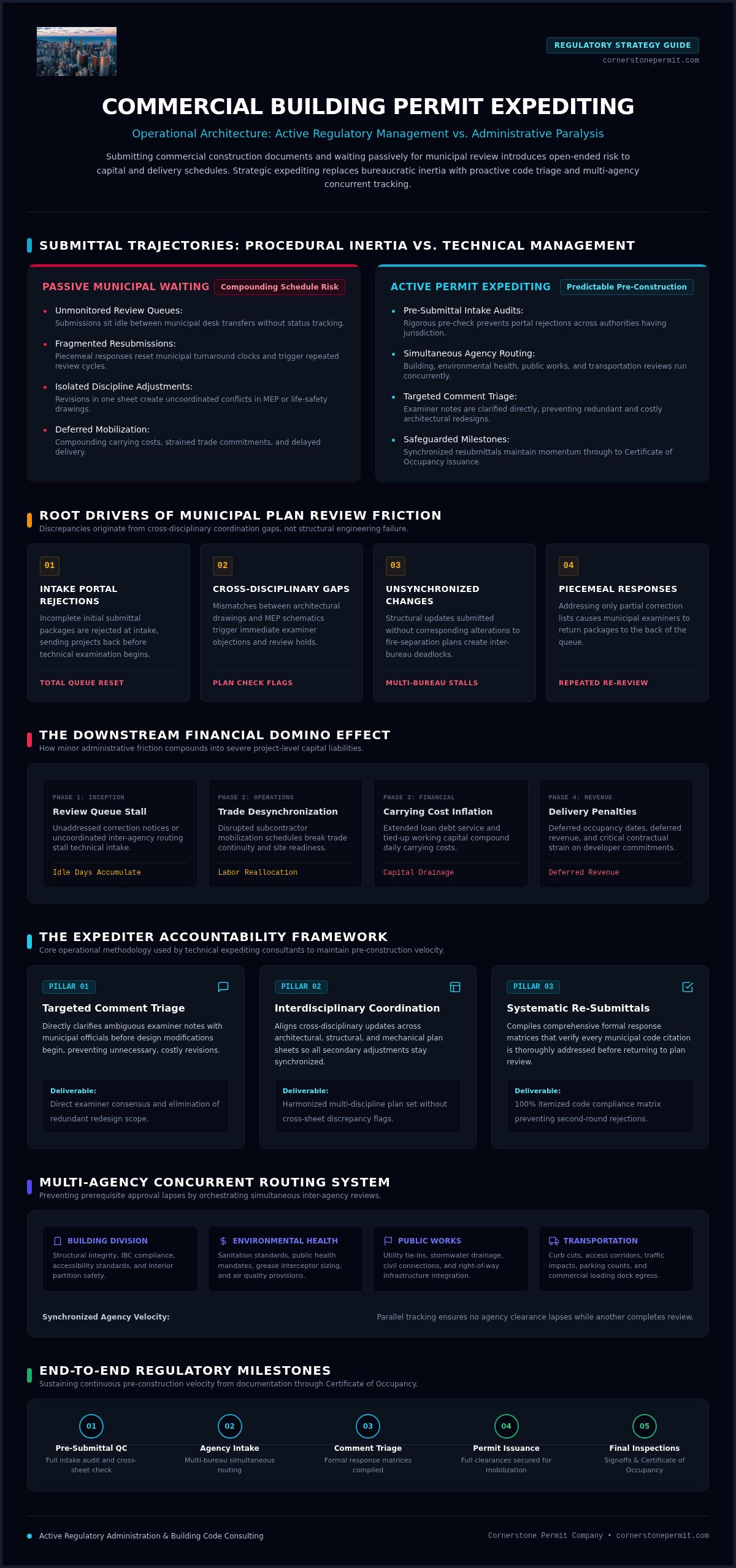
Securing rapid plan approval begins long before upload portals open. Design teams that treat intake as a preliminary test run expose their capital to compounding schedule extensions. Establishing an intentional, front-loaded workflow ensures submittal packages move through departmental channels without administrative rejection or redundant review cycles.
Step 1: Perform Comprehensive Pre-Submittal Plan Audits
Thorough cross-disciplinary reconciliation serves as the first line of defense against plan check flags. Architectural layouts must align precisely with mechanical ductwork, structural framing notes, and plumbing riser diagrams. Beyond drawing sets, verified energy compliance calculations, structural engineering calculations, and accessibility reports must match every cross-referenced callout. Catching discrepancies internally eliminates municipal intake rejections and keeps the review on schedule.
Step 2: Coordinate Concurrent Inter-Agency Reviews
Commercial assets rarely require approval from just a single building division. Complex scopes demand coordinated, concurrent signoffs across multiple authorities having jurisdiction:
- Departmental mapping: Identify upfront whether the scope triggers zoning boards, environmental protection agencies, fire prevention bureaus, or public works departments.
- Preliminary determinations: Conduct preliminary code reviews with agency supervisors for unique architectural features or complex occupancy transitions.
- Utility synchronization: Advance civil utility connections and right-of-way approvals alongside core building reviews to prevent sitework shutdowns.
Step 3: Manage Comment Resolution Workflows Methodically
When municipal examiners issue plan check correction notices, responsiveness dictates velocity. Rather than returning fragmented responses, teams must compile a standardized matrix addressing every municipal code citation line by line. Design revisions require strict version control across all disciplines so modifying an electrical note doesn't invalidate an approved life-safety layout. When technical disputes arise, direct technical discussions with the assigned plan examiner clarify the agency's intent, resolve code misinterpretations, and secure signoff without secondary re-review rounds.
Disciplined building permit expediting transforms these complex steps into an orderly operational protocol. To safeguard your development pipeline against administrative setbacks, partner with Cornerstone Permit Company for full-scope permit management.
Accelerating Project Delivery with Cornerstone Permit Company
Systematic regulatory administration protects construction timelines against bureaucratic delays. Founded in 2014 as a certified Minority Business Enterprise, Cornerstone Permit Company provides nationwide commercial building permit expediting, code consulting, and approval management for contractors and real estate developers. Instead of acting as a passive document courier, our team functions as an indispensable operational partner. We oversee approvals across every phase of development, removing friction between municipal building departments and project teams so you can focus on building.
Full-Spectrum Commercial Regulatory Solutions
Executing complex commercial programs requires managing multiple regulatory tracks simultaneously. Our consultants direct complete approval lifecycles, coordinating primary building authorizations alongside exterior sign permits and Department of Transportation (DOT) right-of-way clearances. Beyond routine processing, we provide specialized building code consulting and ADA accessibility evaluations to address compliance liabilities before inspectors arrive on site. When commercial hospitality or retail scopes require food service and liquor licensing, or when existing properties carry open building violations, our methodical approach clears these hurdles to secure a final Certificate of Occupancy. Standardized reporting protocols provide project stakeholders with predictable, real-time tracking across diverse municipal jurisdictions.
Engaging Professional Regulatory Management
Early involvement creates the greatest operational efficiency. Engaging our team during schematic design allows our specialists to identify zoning hurdles and jurisdictional quirks before documentation is finalized. This upfront triage prevents disruptive architectural revisions during municipal review. Whether you're planning a multi-state commercial development or need to resolve a stalled application stuck in departmental review cycles, the onboarding workflow is clear and efficient.
Disciplined building permit expediting secures critical path milestones and safeguards balance sheets. Submit your drawing packages to Cornerstone Permit Company to initiate an expert submittal audit and establish total control over your municipal approval timeline.
Protect Your Delivery Timeline with Proactive Regulatory Oversight
Commercial construction schedules leave zero room for administrative drift. As municipalities implement complex regulatory mandates and transition to disparate digital portals, passive submittal tracking guarantees costly delays. Securing predictable pre-construction velocity demands rigorous pre-submittal audits, simultaneous inter-agency routing, and disciplined technical triage when examiner comments arise. Professional building permit expediting transforms these fragmented municipal requirements into an organized, risk-mitigated operational workflow.
Cornerstone Permit Company brings institutional precision to every phase of commercial approval. Founded in 2014 as a certified Minority Business Enterprise, our consulting teams provide comprehensive regulatory management across the country. We coordinate multi-agency signoffs, resolve technical code issues, and manage inspections through the final Certificate of Occupancy. Don't let bureaucratic hurdles hold your project back; accelerate your commercial approvals with Cornerstone Permit Company and build with confidence.
Frequently Asked Questions
What does a commercial building permit expediter do during the plan review process?
A commercial building permit expediter manages the technical progression of drawings through municipal departments. Rather than just submitting paperwork, an expediter performs pre-intake quality checks, monitors concurrent agency reviews, and clarifies code objections directly with plan examiners. When correction notices are issued, the expediter organizes the design team's response matrix, verifying that all technical revisions meet local administrative standards before plans are re-examined.
How much time can professional building permit expediting save on commercial projects?
Professional building permit expediting routinely saves project teams several weeks to multiple months, depending on the asset size and jurisdiction. Time savings come primarily from avoiding administrative rejections during initial intake, preventing secondary plan check rounds through rigorous cross-disciplinary coordination, and advancing concurrent inter-agency reviews simultaneously instead of routing them in linear sequence.
Can a permit expediter help if a commercial application has already been rejected?
Yes. If a commercial submittal receives a rejection or an extensive plan check correction notice, an expediter performs technical triage on the examiner's comments. The expediter coordinates directly with the assigned plan examiners to understand specific municipal interpretations, aligns the architectural and engineering teams to address every citation, and resubmits an organized correction package to clear holds quickly.
What is the difference between permit expediting software and professional consulting?
Permit software functions primarily as an administrative portal interface, automating form population and tracking high-level status changes. In contrast, professional regulatory consulting provides technical building code interpretation, inter-agency strategy, and direct representation before plan examiners. When nuanced life-safety, accessibility, or zoning disagreements occur, human consultants possess the technical acumen required to negotiate and resolve compliance disputes.
When in the project lifecycle should a developer engage a permit expediting firm?
Developers should engage an expediting firm during schematic design or early pre-development planning. Involving specialists before construction documents are completed allows teams to identify jurisdictional code amendments, utility coordination requirements, and zoning restrictions upfront. This proactive alignment prevents costly architectural revisions and positions the submittal package for immediate acceptance once uploaded.
Do permit expediters manage specialized reviews like fire, zoning, and health departments?
Full-service commercial expediters routinely manage concurrent reviews across all applicable municipal agencies. Beyond core structural and architectural divisions, they coordinate signoffs from fire prevention bureaus, zoning boards, environmental health departments, and transportation authorities. For specialized commercial spaces, they also oversee food service requirements, liquor licensing, and right-of-way authorizations to ensure comprehensive compliance.
How do expediting consultants assist with final certificates of occupancy and inspections?
Expediting consultants manage the critical transition from active construction to building operation. They coordinate final inspection milestones across building, fire, and health divisions, verify that signoffs are recorded accurately in municipal databases, and address inspection hold points. Once all trade inspections clear, they assemble the necessary documentation packages to secure the final Certificate of Occupancy on schedule.