A permit expediter can keep a commercial project’s application work organized, but cannot control an agency’s decision or review timeline. That distinction matters when submission requirements, review comments, and status follow-ups compete with construction and opening plans. Cornerstone Permit Company coordinates administrative tasks, track applications, and helps organize responses as review proceeds.
Review sequences and resubmissions can add work for a project team already managing multiple deadlines. This article explains what permit expediters handle, which decisions remain with your team, and how to assess support based on scope, communication, and follow-through. It also covers how building permits, related approvals, and compliance requirements can be coordinated around project milestones without promising approval.
Key Takeaways
- Permit expediting coordinates application documents, submission tracking, review-comment follow-up, and closeout tasks. Agency decisions remain outside the expediter’s control.
- Chicago Permit Expediters can help organize review activity, but complete, consistent application materials and timely project-team decisions remain essential.
- Compare internal coordination with delegated support by assessing staff capacity, permit complexity, the number of stakeholders, and the follow-up each project requires.
- Prepare by assembling the project scope, ownership details, plans, existing approvals, and key milestones. Designate one contact to consolidate decisions.
- Coordinated support across permits, licensing, inspections, and compliance requirements can help teams manage connected approvals as project needs evolve.
What Permit Expediters Do for Commercial Construction Projects
Commercial permitting involves more than delivering an application. Plans and supporting information must be assembled, submission steps coordinated, review comments routed to the right people, and outstanding items tracked through the applicable process. Permit expediting is the administrative and regulatory coordination that keeps this work organized.
Building codes shape plan review and compliance; building codes provide useful background on the rules behind that process. A permit expediter can manage application logistics and follow-up, but the authority having jurisdiction controls its review procedures and approval decisions. The project team remains responsible for supplying accurate information and making technical decisions.
For project teams engaging Chicago Permit Expediters, this division of responsibility is central. Coordination can reduce preventable administrative friction, but it cannot replace complete project information or determine an agency’s outcome.
Which project tasks can a permit expediter manage?
Using plans and information supplied by the project team, an expediter can coordinate application preparation and submission, monitor status, and maintain a record of outstanding steps. When an agency issues comments, the expediter can route them to the responsible project professionals, track responses, and coordinate resubmission logistics.
- Document coordination: Organize application materials and identify missing administrative items.
- Submission tracking: Record status updates and follow-up actions.
- Review-comment routing: Direct technical questions to the appropriate project professionals and track response progress.
- Related approvals and closeout: Coordinate applicable permits, inspections, and certificate-of-occupancy milestones.
This support keeps administrative steps visible while leaving design, construction, and technical responses with the project team and its responsible professionals.
What does “expediting” mean, and what does it not mean?
Permit expediting means coordinating application materials, submissions, status tracking, and follow-up. It does not mean making regulatory decisions. Organized submissions and timely responses may help limit avoidable delays caused by administrative gaps or missed follow-up. They do not guarantee approval, override review requirements, or dictate how long an agency takes to complete its review.
The expediter manages the process around the application. The project team verifies that submitted information accurately reflects the proposed work and provides the technical direction needed to address comments. Clear ownership on both sides keeps the review record organized and supports realistic coordination with project milestones.
How Permit Expediting Moves an Application Through Review
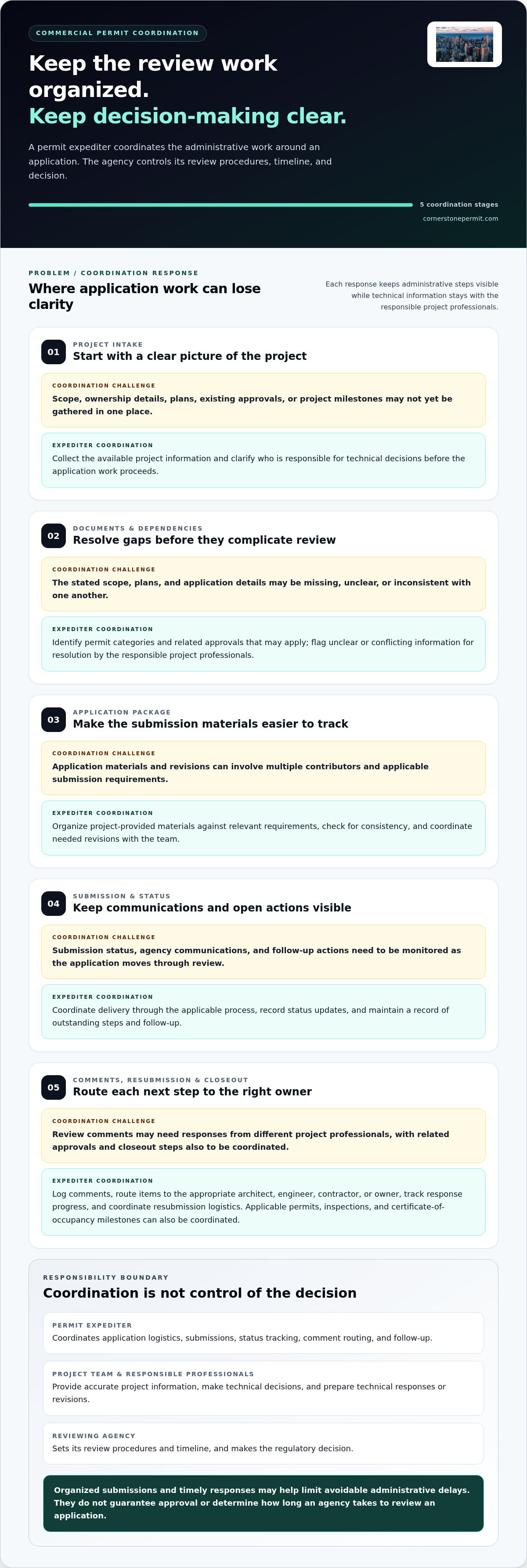
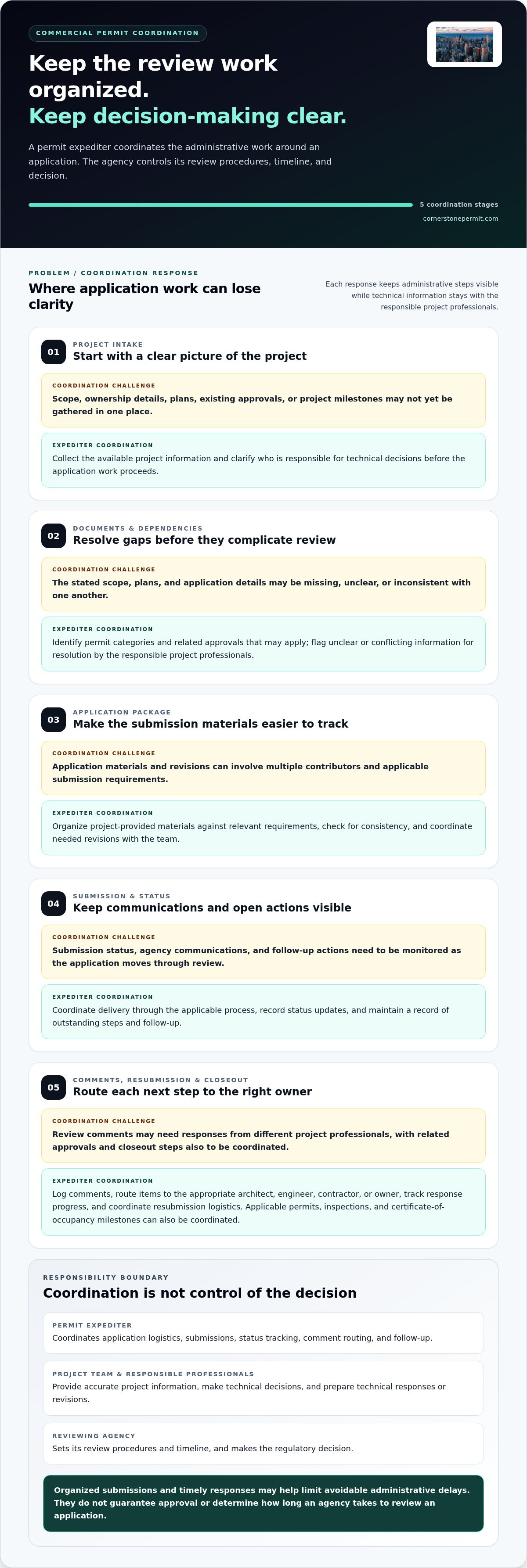
A coordinated review process starts with project information, not the submission button. Chicago Permit Expediters can help organize the sequence of administrative steps, while each authority sets its own submission requirements, review sequence, and decision timeline. The workflow below offers a practical framework; the exact path depends on the project scope and applicable approvals.
- Intake the project. Gather the work scope, ownership details, available plans, existing approvals, and key construction or opening milestones. Clarify what information is available and who is responsible for technical decisions.
- Review documents and dependencies. Identify permit categories and related approvals that may apply to the described work. Flag missing, conflicting, or unclear information for resolution by the responsible project professionals before submission.
- Coordinate the application package. Organize project-provided materials against relevant submission requirements, check that information is consistent, and coordinate any needed revisions with the team.
- Submit and track. Coordinate delivery through the applicable process, record submission status, and keep outstanding actions and agency communications visible.
- Manage comments and next steps. Log review comments, assign each item to the appropriate architect, engineer, contractor, or owner, and track responses and resubmission coordination.
What happens before an application is submitted?
Early document review can reveal gaps that might otherwise prompt avoidable questions. For example, if the stated scope, plans, and application details describe different work, the responsible project professionals can resolve the discrepancy before it complicates review. The expediter coordinates this process but does not create or certify technical project information.
Project coordination is also part of the wider professional environment represented by the American Institute of Architects. Clear responsibilities for administrative coordination and technical decisions help keep application materials organized without blurring who owns each response.
How are review comments, inspections, and closeout coordinated?
When comments arrive, the expediter can record each item, route it to the person responsible for the response, monitor outstanding actions, and coordinate the next submission. Technical answers and revisions remain with the appropriate project professionals. This division keeps follow-up organized while preserving responsibility for the content.
As work progresses, inspection scheduling and related documentation can be coordinated against construction milestones and applicable closeout steps, including certificate-of-occupancy requirements. Documented comments, assigned owners, tracked responses, resubmission status, inspection coordination, and closeout milestones give the team a clearer view of what has moved forward and what remains open.
For projects with several connected approvals, permit application coordination can consolidate administrative handoffs while the project team retains responsibility for accurate information and technical decisions.
When Is a Permit Expediter Worthwhile for a Project?
A project team can file applications on its own. The question is whether it also has the capacity to track submissions, manage review comments, coordinate related approvals, and follow through alongside its other responsibilities. Chicago Permit Expediters provide administrative coordination; they do not replace the project team’s technical judgment or control agency decisions.
| Consideration | Internal coordination | Delegated expediting |
|---|---|---|
| Capacity | Staff handle filing and follow-up alongside other project duties. | Administrative tasks and status tracking are assigned to an expediting partner. |
| Complexity | The team coordinates the application and related steps across its own roles. | One coordination workflow can help organize multiple permits, reviewers, or phases. |
| Follow-up | Internal staff track comments, document versions, responses, and inspection needs. | Follow-up and handoffs are managed within a defined scope. Technical responses remain with the responsible professionals. |
Which project conditions increase the value of outside coordination?
Outside coordination may be useful when a project involves concurrent permit types, multiple reviewers, phased work, or occupancy milestones linked to construction progress. Assess whether internal staff can consistently track comments, deadlines, document versions, and inspection needs. These are administrative demands; technical design decisions and professional responses remain with the responsible project professionals.
A simpler application may be manageable internally if one person has clear ownership and time for ongoing follow-up. As approvals or stakeholders multiply, coordination can require more frequent handoffs and careful version control. Consider the workload and risk of missed follow-through, not a promised reduction in review time.
What should a useful service comparison include?
Compare the work included, not broad claims about speed. A clear scope identifies who coordinates submissions, communicates status, routes agency comments, and tracks responses and resubmissions. It should also explain how related approvals, inspections, and closeout tasks fit into the project workflow.
Before choosing an approach, map each open task to an owner. If the project team can maintain that record and respond reliably, internal coordination may be sufficient. If responsibilities are divided or follow-up competes with core project duties, delegated administrative support can provide a more orderly process. Approval decisions and review durations remain with the relevant authorities.
How to Prepare for Permit Expediting Support
A well-organized intake gives the project team and its permit expediter a shared starting point. Before engaging Chicago Permit Expediters, assemble available project information, identify decision-makers, and note the milestones approvals need to support. The goal is a clear administrative record, not a substitute for technical review by the responsible professionals.
What project information helps establish a clear scope?
Gather the details that describe the work and its approval history. Include:
- Project identifiers: Site address, ownership details, and the intended use of the space.
- Scope of work: A concise description of proposed construction, alterations, or operational changes.
- Plans and records: Current plan documents, existing approvals, prior submissions, and available agency correspondence.
- Potential approval needs: Building, sign, DOT, food-service or liquor licensing, inspection, and occupancy-related items, as relevant to the project.
- Milestones and owners: Target construction and opening dates, project stakeholders, and the people authorized to approve revisions or provide technical responses.
Mark gaps and conflicting details rather than resolving technical questions through assumptions. For example, if the proposed scope differs between project records, identify the discrepancy and assign it to the responsible project professional to clarify.
How can teams keep permitting communication organized?
Designate one project contact to consolidate decisions, route technical questions, and prevent communications from fragmenting across multiple channels. Maintain a shared log with submission dates, document versions, agency comments, assigned responders, next actions, and current status. When a plan or application is revised, label the current version clearly so outdated materials are not circulated by mistake.
Agree on a regular cadence for internal status updates and record what remains outstanding. This keeps follow-up visible without assuming when an authority will respond. For additional guidance, consult related resources on expediting a building permit and responding to a permit rejection, and use their steps alongside the requirements and communications applicable to your project.
Organized intake helps Cornerstone coordinate applications and related follow-up around the information your team provides. Discuss permit coordination for your project with Cornerstone.
How Cornerstone Permit Company Supports Permit Coordination
Cornerstone Permit Company manages permit applications and regulatory processes for construction and hospitality projects across the country. The company coordinates administrative requirements and follow-up so project teams can track related approvals alongside construction and opening milestones. Its role is process management: agencies retain authority over review procedures and approval decisions, while project professionals remain responsible for technical information.
Which permitting and compliance needs can Cornerstone coordinate?
Project requirements can connect several administrative tracks. Cornerstone supports building permits; sign and DOT permits; food-service and liquor licensing; building violation resolution; certificates of occupancy and DOB inspections; ADA compliance and accessibility consulting; building-code consulting; and underground coordination.
For example, a commercial project may need permit activity coordinated with licensing, inspections, or occupancy-related milestones. Organizing these connected requirements through a coordinated process helps the team track responsibilities and outstanding steps rather than managing each administrative thread in isolation. The coordination is shaped by the project scope and applicable approvals.
What makes Cornerstone a qualified operational partner?
Founded in 2014 by Ashish Shah, Cornerstone is a Certified Minority Business Enterprise. The company manages permit processes from plan review through certificate-of-occupancy milestones, coordinating applications and follow-up across connected project requirements. This continuity helps teams keep submissions, agency comments, related inspections, and closeout tasks visible as a project advances.
Cornerstone’s role complements the project team’s work. The company coordinates the regulatory process, while project stakeholders provide accurate project information and make the technical decisions and responses assigned to them. Approval remains with the authority having jurisdiction, and a private expediting firm does not control review duration.
For teams evaluating Chicago Permit Expediters, the practical consideration is whether administrative coordination aligns with the project’s permits, licensing, compliance, and occupancy needs. Cornerstone brings these related processes into a structured workflow, helping project teams manage follow-through without confusing coordination with control over agency outcomes.
Discuss your project’s permit and regulatory coordination needs with Cornerstone Permit Company to identify the administrative requirements and handoffs that need managing.
Move Your Project Forward With Coordinated Permitting
Effective permit expediting organizes application materials, tracks agency follow-up, and coordinates related approvals. The project team remains responsible for accurate information and technical decisions. For commercial teams considering Chicago Permit Expediters, the right support depends on project complexity, internal capacity, and the follow-through the work requires. No expediter can control agency decisions or review timelines.
Cornerstone Permit Company coordinates permits and related regulatory work across applications, licensing, compliance, and closeout support. Founded in 2014 by Ashish Shah, Cornerstone is a Certified Minority Business Enterprise and manages permit processes from plan review through certificate-of-occupancy milestones.
Give your team a clearer view of project requirements and administrative handoffs. Discuss your project’s permit and regulatory coordination needs with Cornerstone.
Frequently Asked Questions
What does a permit expediter do?
A permit expediter coordinates the administrative work involved in moving an application through review. Tasks may include organizing project-provided documents, coordinating submissions, tracking application status, routing agency comments to the responsible professionals, and monitoring resubmissions or closeout steps. Chicago Permit Expediters support process management, not technical design or regulatory decision-making. The project team remains responsible for accurate project information and technical responses, while the authority having jurisdiction controls review procedures and approval decisions.
Can a permit expediter guarantee approval or a faster review?
No. A permit expediter cannot guarantee approval or dictate how long an agency takes to review an application. The relevant authority sets review procedures, requirements, and decision timelines. Organized documents, clear responsibility for comments, and timely follow-up may help reduce avoidable administrative friction, but they do not determine the outcome. Treat expediting as coordinated process support, not a promise of approval or a fixed review schedule.
When should a contractor hire a permit expediter?
A contractor may benefit from expediting support when permit tasks compete with construction responsibilities or involve several applications, reviewers, stakeholders, or project phases. Support can also help when the team needs to coordinate review comments, document versions, inspection requirements, and occupancy milestones. A contractor can file independently if staff have clear ownership and capacity for tracking and follow-through. The decision depends on administrative workload, not a guarantee of faster agency review.
What documents should I prepare before permit expediting begins?
Gather the project scope, ownership details, current plans, existing approvals, relevant agency correspondence, and key construction or opening milestones. Include available information about intended use and related building, sign, DOT, licensing, inspection, or occupancy needs. Identify the project contact, stakeholders who can approve revisions, and professionals responsible for technical responses. If records conflict or information is missing, flag it for resolution rather than relying on assumptions.
How much does a permit expediter cost?
Permit expediting costs depend on the project scope and coordination required. Relevant factors may include the number of applications, related approvals, review cycles, and closeout tasks. Since projects differ, a general industry figure may not reflect the work required for a specific engagement. Compare services by their defined scope, communication responsibilities, status reporting, and resubmission coordination, rather than relying on price alone or an unsupported promise of speed.
What is the difference between a permit expediter and an architect?
A permit expediter manages administrative coordination, such as organizing application materials, tracking review status, and coordinating follow-up. An architect provides architectural design and related professional work within the project team’s scope. These roles may interact during permitting, especially when review comments call for technical input or revised plans. The expediter can route and track those comments, but the responsible project professional provides the technical response, and the reviewing authority makes the approval decision.
Can a permit expediter help after an application is rejected?
Yes. An expediter can organize the rejection notice or review comments, record each outstanding item, route technical questions to the responsible project professionals, and coordinate the administrative steps for a response or resubmission. The project team must resolve technical issues and provide accurate revisions; the expediter tracks handoffs and follow-up. Resubmission does not guarantee approval, because the authority retains control of its review and decision.